
关键词 > WSC
WSC 2024: Simulation Challenge Tech. Document
发布时间:2025-06-24
Hello, dear friend, you can consult us at any time if you have any questions, add WeChat: daixieit
WSC 2024
Simulation Challenge
Tech Document
SUMMARY
The Simulation Challenge at the Winter Simulation Conference (WSC), evolving from its initial launch in 2022 as the "Case Study Competition", continues to underscore the critical role of simulation in bridging the gap between academia and industry. This initiative thrives on promoting interdisciplinary collaboration, sparking innovation, and addressing real-world challenges with advanced simulation solutions.
This year, aligning with the WSC 2024 theme “Simulation for the Imagination Age”, the Challenge invites creators to unleash the potential of simulation technology in transforming maritime systems. As we navigate a world increasingly reliant on complex maritime logistics for global trade, we are shifting our focus towards empowering participants to reimagine the future of port operations, yard management, and cargo logistics. The challenge encourages participants to harness their creativity to design, optimize, and evaluate dynamic systems using simulation, crafting solutions that meet the ever-evolving demands ofthe maritime industry with ingenuity and foresight.
This year's Challenge pivots towards maritime logistics, focusing on a cargo port operation issue involving complex interactions and activities within a cargo port, from ship berthing to container handling and automated guided vehicle (AGV) management. Participants are invited to optimize cargo port operations to improve efficiency and foster creative solutions. We have built a basic simulation system model with discrete-event modeling methods. The model is implemented in C# programming language using O2DES.NET which is a set of frameworks for object-oriented discrete event simulation. In this competition, participants are required to build, design, and implement their own strategy algorithm. Participants are expected to embed their own algorithms in certain parts of the model, using their skills in model training and large-scale search, with the objective of improving port operation performance. The team that generate the best overall performance stand the best chance to win.
The purpose of this document is to provide the participants with detailed descriptions ofthe model structure and to guide them through the process of downloading the files and the required procedures for submitting their solutions.
Chapter 1.
Overview
1.1 Problem Description
Welcome to the WCS Simulation Challenge 2024 where this year's challenge is dedicated to simulating port operations. As global trade escalates, the efficiency of port operations becomes critical for economic continuity and competitiveness. Participants are invited to delve into the complex management of a container port terminal, emphasizing the optimization of interactions between vessels, containers, and port machinery including quay cranes (QCs), yard cranes (YCs), and automated guided vehicles (AGVs).
Traditional port operations often struggle with inefficiencies stemming from manual processes and static scheduling. These conventional methods can lead to significant delays in vessel berthing, container misallocation, and suboptimal usage of AGVs and cranes. In this competition, for each vessel arriving at the port, a waiting time exceeding two hours before berthing is considered a failure. Our goal is to reduce such failures and the final assessment of solutions submitted for this competition will be based on this performance metric.
In response to these challenges, our competition introduces a simplified but comprehensive port model. This model is centered around three critical decision variables: scheduling vessel berths, allocating containers to specific yard blocks, and assigning AGVs. These variables traditionally rely on fixed schedules and limited real-time data, leading to inefficiencies in throughput and resource allocation. This year, we encourage participants to reimagine these operations using advanced, innovative methods. By employing cutting-edge technologies and methodologies such as simulation, deep learning, and other data- driven approaches, contestants have the opportunity to significantly enhance the port’s operational efficiency.
This competition is not only about devising winning strategies but also about fostering learning and discovery in port logistics. We aim for the participants to gain deep insights about the operational complexities of ports and to explore creative, efficient solutions to these real-world challenges. It is an opportunity to apply the theoretical knowledge practically, which may lead to not just personal growth but potentially transformative changes within the industry. We look forward to seeing the unique perspectives and innovative solutions that each participant will bring to the WCS Simulation Challenge 2024. So, engage in this exploration of modern port operations, apply your skills, and enjoy the process of pioneering the future of port logistics!
Good luck and have fun in the WCS Simulation Challenge 2024!
1.2 Competition Rules
As shown in Figure 1, the given model contains data and source code according to the following three building blocks of information flow:
(A) Input: Example simulation scenarios with specific parameters settings.
(B) Interface: The three decision-modules. Here is where users can modify the code for their own
decision algorithms for scheduling vessel berths, allocating containers to specific yard blocks, and the assignment of AGVs. The respective names for the methods are “CustomeizedAllocatedBerth”,
“CustomeizedDetermineYardBlock”, and “CustomeizedAllocatedAGVs” . The default algorithms are be provided too.
(C) Output: Performance indicators to measure the efficiency and quality of the port operations.
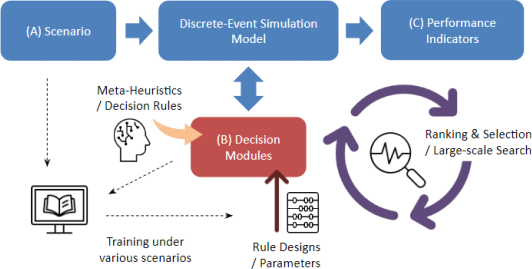
Figure 1 - Information flow diagram.
In this contest, you are expected to rewrite and replace the existing decision modules (in Block B), to maximize the archived performance of the system (in Block C) under different scenarios (from Block A).
You can generate the logic rules in Part (B) in various ways, including but not limited to:
a. Writing rule-based scripts or heuristic algorithms embedded in decision events,
b. Embedding this simulation model into some external optimization search algorithms,
c. Developing a machine learning model to identify and conclude the best rule parameters and embedding them in the decision events.
You only need to provide Part (B) of the program code (with any required data), and there is no need to submit your optimization and training programs.
Please Note: Other source codes (except those for Part B) will not be evaluated or run by the assessors.
1.3 General Conditions of the Challenge
Your data and program code will be embedded in the discrete-event simulation model (that we have provided in advance). It will overwrite the corresponding original code, then it will be compiled and generates an executable simulation program. Your program will run under a variety of scenarios and random seeds. The winner will be the one whose model generates the top average performance index for each case.
For further instructions regarding file downloads and programming please check Chapter 2. Simulation model structures and the available data is explained in Chapter 3. Last but not least, the submission guidelines and detailed assessment criteria for this competition can be found in Chapter 4.
Chapter 2.
Technichal Instractions
2.1 Installing Visual Studio
1) Go to Microsoft website https://visualstudio.microsoft.com/ Then, choose the version that suits your computer and click the Download button to download This IDE.
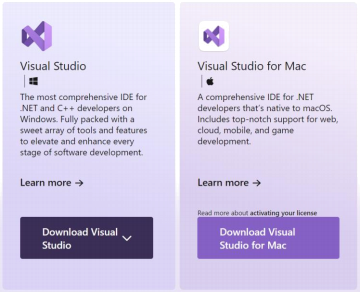
Figure 2 - Microsoft Visual Studio download page.
2) For detailed instructions on the installation steps, you may refer to the following links:
Windows OS: https://learn.microsoft.com/en-us/visualstudio/install/install-visual-studio?view=vs-2022 Mac OS: https://learn.microsoft.com/en-us/visualstudio/mac/installation?view=vsmac-2022
3) You should select the workload to run the provided simulation model using C# language.
2.2 Source Code (in C#)
1) After registration, you will receive the zip package of our source code by email. The file will look like “WSC Simulation Challenge 2024.zip” .
2) Unzip the package.
3) Figure 3 shows the structure of the provided Source code for the challenge:
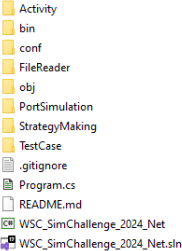
Figure 3- A glance on the content of the provided source code.
Here, the conf folder includes the scenario files, and StrategyMaking folder includes the Default and DecisionMaker files.
4) You may open the project by double click on “ WSC_SimChallenge_2024_Net.sln ”. For
compiling and running the code, you may simply click on the green play button on the top part of the window (shown with a red arrow in Figure 4).
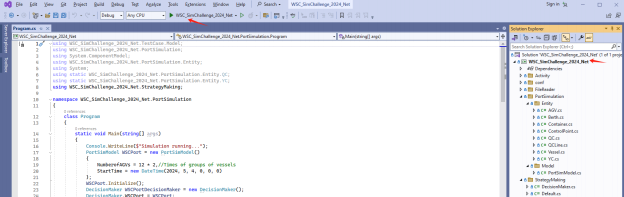
Figure 4- the provided C# code in Visual Studio.
Chapter 3.
Discrete-Event Simulation Model
3.1 Entities
There are seven entities involved in this model, Quay Crane (QC), Berth, Container, Automated Guided Vehicles (AGV), Vessel, Yard Block and Yard Crane. Each is represented by a class and has its own set of attributes. The Entity Relationship Diagram (ERD) is shown in Figure 5 to give an overview of the relationships among the entities and the attributes associated with them.
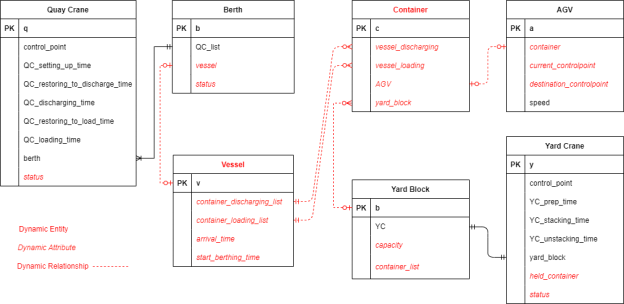
Figure 5- Entity Relationship Diagram (ERD).
Notes about Figure 5:
1) PK: primary key, which uniquely identifies the entity object.
2) Static attribute: entity attributes that do not change over time. These attributes are owned by the class itself (shown in black color in the ERD).
3) Dynamic attribute (italic): entity attributes that change over time (in red color).
3.1.1 Entity Relationships
The following relationships are in place between the mentioned entities of the system:
 Each Berth has one or many Quay Cranes.
 Each QC corresponds to exactly one Berth.
 Each Berth has either zero or one Vessel.
 Each Vessel corresponds to either zero or one Berth.
 Each Vessel has zero or many Containers.
 Each Container corresponds to exactly one Vessel.
 Each Container corresponds to either zero or one AGV.
 Each AGV can have either zero or one Container.
 Each Container corresponds to either zero or one Yard Block.
 Each Yard Block can have zero or many Containers.
 Each Yard Block has one and only one Yard Crane (i.e., each YC corresponds to one and only one Yard Block).