Hello, dear friend, you can consult us at any timeif you have any questions, add WeChat: daixieit
Assignment 1
MATH1062: Mathematics 1B Semester 1, 2026
Lecturers: June Park and Yeeka Yau
This individual assignment is due by 11:59pm Sunday 22 March 2026, via Canvas. Late assignments will receive a penalty of 5% per day until the closing date. Please make sure you review your submission carefully. What you see is exactly how the marker will see your assignment. Submissions can be overwritten until the due date. To ensure compliance with our anonymous marking obligations, please do not under any circumstances include your name in any area of your assignment. The School of Mathematics and Statistics encourages some collaboration between students when working on problems, but students must write up and submit their own version of the solutions. Even though the use of AI is allowed, it is better for your learning to do your own work to complete the assignment. If you have technical difficulties with
your submission, see the University of Sydney Canvas Guide, available from the Help section of Canvas.
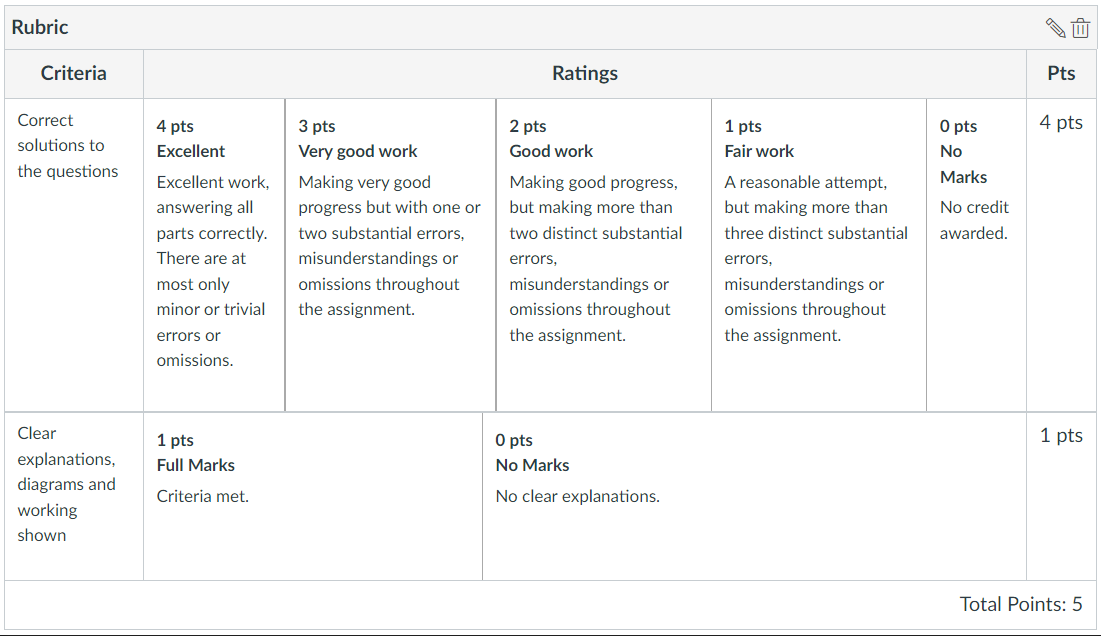
This assignment is worth 5% of your final assessment for this unit. Your answers should be well written, neat, thoughtful, mathematically concise, and a pleasure to read. Please cite any resources used, including AI, and show all working. Present your arguments clearly using words of explanation and diagrams where relevant. After all, mathematics is about communicating your ideas. This is a worthwhile skill which takes time and effort to master. The marker will give you feedback and allocate an overall mark to each part of your assignment using the following criteria:
Part A: Calculus
Submission Instructions
• Solutions to Part A must be uploaded as a single pdf file to the Canvas page for MATH1062 Calculus Assignment 1.
• Justify your answers by showing all relevant working. Correct answers without adequate justification will not receive full marks.
1. Find the General Solution and Particular Solution of the following differential equation:
dy/dx − 3x
2
y + 2y = 0, y(0) = 5
2. A given population of bacteria is modelled by the differential equation
dP/dt = k P,
where P(t) is the number of bacteria at time t (in hours) and k is the constant of proportionality.
(a) Find the general solution of this equation.
(b) Find an exact expression for k given that the bacteria population quadrupled in 8 hours.
(c) The initial population of bacteria is 3,000. How long would it take for the population to grow to 15,000? Give your answer to the nearest hour.
3. A motorboat starts from rest (initial velocity v(0) = 0). Its motor provides a constant acceleration of 3 ft/s2
, but water resistance causes a deceleration of v2/300 ft/s2
.
(a) Set up and solve the differential equation for v(t).
(b) Find the limiting velocity as t → ∞ (that is, the maximum possible speed of the boat).
Part B: Statistics
Submission Instructions
• Solutions to Part B must be prepared as a single html file and submitted to the Canvas page for MATH1062 Data Assignment 1.
• You need to write your solutions as either embedded R code (in the provided code cell blocks) or text answers in the provided Quarto document, and then generate the html file using Render in RStudio. We can only mark the html file.
Questions
Part B questions are provided in the R Quarto Document located on the Canvas page: Canvas page for MATH1062 Data Assignment 1.