PUBPOL5750 MOCK PRELIM Examination
Hello, dear friend, you can consult us at any time if you have any questions, add WeChat: daixieit
MOCK PRELIM Examination
Course Name: PUBPOL5750
Date: March 4, 2026
1. (50 points) In this question, you are asked to manually calculate a bivariate regression line.
Round all calculations to two decimal places.
A researcher is interested in the relationship between the number of training sessions attended and worker productivity (measured as units produced per day).
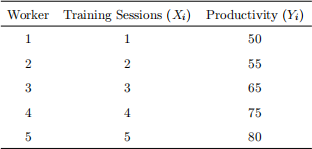
(a) Fill up the first three columns (columns 1-3) of the table as requested (each column is worth 5 points).
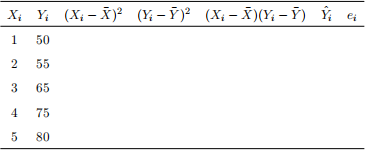
(b) (20 points) Calculate the intercept (b0) and the slope (b1) for the regression:
Productivityi = β0+ β1Trainingi + ϵi
(c) Fill up the last two columns ( and ei). Each column is worth 5 points.
(d) (5 points) Show that the following holds (rounding errors acceptable):

2. (50 points) You will be asked to interpret regression results for this question.
BACKGROUND: Researchers are interested in understanding the determinants of hourly wages. In addition to gender, factors such as education and work experience may play an important role.
The researcher estimated the following regressions:
• Regression 1: Hourly wage regressed on a female dummy variable.
• Regression 2: Hourly wage regressed on the female dummy and years of education.
• Regression 3: To explore additional factors, the researcher included years of experience and a training indicator.
Table 1 presents the results.
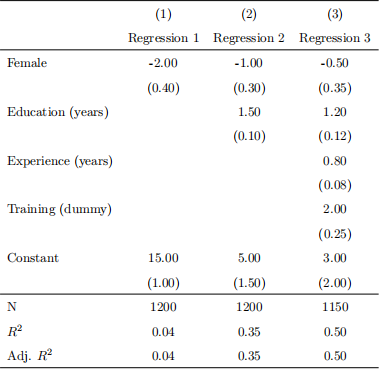
Education is measured in total years of schooling completed.
Experience is measured as years in the labor market.
Training is a dummy variable equal to 1 if the worker completed a professional training program.
(a) (10 points) Using Regression 1, compute the mean hourly wage for males and females. Interpret the coefficient on the Female variable.
(b) (10 points) Compare the coefficient on Female across Regression 1 and Regression 2. Why does the coefficient change after adding Education? Explain your answer.
(c) (10 points) Interpret the coefficient on Education in Regression 2. Then compare it to the coefficient in Regression 3. Why does it change after adding Experience and Training?
(d) (10 points) Interpret the R2 in Regression 2 and Regression 3. Why does R2 increase when additional regressors are included?
(e) (10 points) Can we interpret any of these coefficients as causal? Why or why not?
2026-03-05