PHIL1007 Intensive Introductory Logic Summer 2026 Practice Take Home Exam
Hello, dear friend, you can consult us at any time if you have any questions, add WeChat: daixieit
PHIL1007
Intensive Introductory Logic
Summer 2026
Practice Take Home Exam
Please note:
• This practice exam is not submitted or marked; it exists only to give you a sense of what sort of questions are possible for the real exam. There is no guarantee of a close resemblance between the balance of topics in this prac- tice exam and what you will face in the real exam. (This practice exam is drawn from past exams and the assessed content may have changed.)
• This exam has 7 (seven) questions. Please answer every question.
• Numbers in the margins indicate marks assigned to each question. The exam is worth 100 marks in total.
• Be sure to show your working to help us allocate partial credit.
• This is an open-book exam, and you may use the textbook (forallz Ad- elaide), lectures, quizzes, and exercises to help you. You should act with integrity at all times during the examination, and avoid collusion.
• You have 24 hours to complete the exam once you begin.
• The real exam will be provided using Cadmus, not a separate pdf.
START OF THE EXAM PAPER
[10 marks]
1. Identify premises and conclusions in the following arguments. For each ar- gument, note whether it is valid, conclusive, or neither (in English). Comment on any tricky issues.
(a) ‘At least one child is tired, as two children are tired.’
(b) ‘Nobody blinded Polyphemus, since Odysseus blinded Polyphemus, and Odysseus is Nobody.’
(c) ‘This glass is fragile, so this glass would break if it were dropped.’
(d) ‘Everybody supposes that what exists must exist somewhere, because
what does not exist is nowhere.’ (Aristotle Physics 208a 27)
[15 marks]
2. Symbolise each of the following arguments into Sentential, giving an ap- propriate symbolisation key in each case. For each symbolised argument, evaluate whether it is valid or invalid, using (complete or partial) truth tables. Comment on any diff1culties or points of interest that arise.]
(a) ‘If that’s a lungf1sh, it doesn’t have gills. If that’s not a lungf1sh, it’s a weird-looking rat; and if it’s a rat, it lacks gills. So that doesn’t have gills.’
(b) ‘If a plane departs from the international terminal, it’s an international flight. This flight departed from a different terminal. So it’s not an in- ternational flight.’
(c) ‘The dog … having tracked down the two roads along which the wild an- imal did not go, starts off at once along the third without tracking down it. For, our earlier author sayas, he is implicitly reasoning as follows: “The animal went either this way or this or this; but neither this way nor this: therefore this way.”’ (Sextus Empiricus, Outlines of Pyrrhon- ism, I: 69) Is the dog’s reasoning valid?
[15 marks]
3. Construct natural deduction proofs demonstrating the following. Be sure to properly annotate your proof to show your working.
(a) ((C → E) Λ (→C → →E)) ⊢ C ↔ E;
(b) (((A Λ B) → C) Λ ((→A Λ B) → C)) ⊢ (B → C);
(c) ⊢ (((→Q → →P) Λ →(Q Λ →R)) → (P → R)).
[10 marks]
4. This question explores a slightly alternative proof system to the one we use in fo rallz Adelaide.
(a) Construct a proof, using only the standard natural deduction rules, that ⊢ ((A → B) ↔ ¬(A Λ ¬B)).
(b) The proof you have just provided shows that (A → B) and →(A Λ →B) are provably equivalent. That justif1es the following derived rules, which allow you to swap the former for the latter, and vice versa:
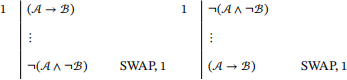
Consider the modif1ed natural deduction system which includes these SWAP rules in place of the introduction and elimination rules govern- ing the conditional. Show that in this modif1ed system it is possible to establish our familiar conditional rules as derived rules.
[16 marks] 5. Consider the following interpretations, presented diagrammatically, and the given sentences.
(a) Consider an interpretation presented in this Euler diagram and evaluate the following sentences. For each sentence, say if it is true or false in the interpretation, and briefly explain your reasoning.
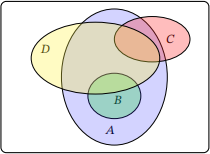
i. ∃x(¬Bx Λ ¬Cx);
ii. ∀x(Cx → (¬Ax → Dx));
iii. ∀x(Dx → ∃y(By Λ x ≠ y));
iv. ∃x∃y∃z(Bx Λ (By Λ (Bz Λ (x ≠ y Λ (y ≠ z Λ x ≠ z))))).
(b) Consider the interpretation in this directed graph for the two-place pre- dicate ‘R’ on the set of items named a, b, c and evaluate the following sentences. For each sentence, say whether it is true or false in the inter- pretation, and briefly explain your reasoning.
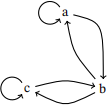
i. ∀xRxa;
ii. ∀x∀y(Rxy → ∃z(Ryz Λ y ≠ z));
iii. ∀x∀y((Rxy Λ Ryx) → x ≠ y);
iv. ∀x∀y∀z((Rxx Λ (Ryy Λ Rzz)) → ∀v(Rvv → (x = v ∨ (y = v ∨ z = v)))).
[20 marks]
6. For each of the following arguments, symbolise into Quantifier, and either provide an interpretation demonstrating its invalidity, or explain why it is valid. Comment on any points of diff1culty or interesting features.
(a) ‘If someone is at any time a person, it is always a person. So ifFido isn’t a person at this time, he never is a person.’
(b) ‘Not all music fans regard A Love Supreme as their favourite Coltrane record. So there are at least two Coltrane records.’
(c) ‘Anything that can cause itself is a God, and every event must have some- where among its causes some cause that either causes itself, or lacks a cause. So God exists.’
[14 marks]
7. Construct natural deduction proofs verifying the following:
(a) ∀x(Fx → Gx); ∀Y(GY → →HY) ⊢ ∃xFx → ∃Y(FY Λ ¬HY));
(b) ∀x∀Y(RxY ∨ RYx) ⊢ ∀x(→Rxx → ∀ZRxZ).
2026-02-24