ECO 373 Environmental Economics Homework 2
Hello, dear friend, you can consult us at any time if you have any questions, add WeChat: daixieit
Homework 2
ECO 373
Problem 1: Temperature and Electricity Demand
The purpose of this assignment is to explore how residential electricity consumption responds to climate conditions using publicly available data. You will formulate an economic model, collect and clean data, estimate a simple regression, and interpret the results.
Research Question: How does variation in temperature affect electricity consumption across U.S. states?
Economic Model:

Where:
• ElecUsest: Monthly residential electricity consumption in state s and time t
• CDDst: Cooling Degree Days (heat exposure)
• HDDst: Heating Degree Days (cold exposure)
• Pricest: Residential electricity price
• ϵst: Error term
Data Collection
Use data from the following sources:
• Electricity consumption and price: EIA Monthly State Electricity Profiles
• Temperature data (CDD/HDD): EIA Weather Data or NOAA Climate at a Glance
Instructions:
1. Download monthly data from January 2020 to December 2023.
2. Combine data into one Excel file with variables: state, month, electricity use, price, CDD, HDD.
3. Provide summary statistics (mean, standard deviation).
Estimation and Results
Use Excel or R to estimate the model.
• Run the OLS regression and report the coefficient estimates and R2 .
• Plot electricity use against CDD and HDD (scatter or line plot).
Interpretation:
• What is the impact of temperature (CDD/HDD) on electricity use?
• Is demand sensitive to price?
• Are the signs and magnitudes of the coefficients consistent with theory?
Submission
• Submit one zipped folder with:
– Clean dataset (Excel or CSV)
– Regression output (Excel summary or R output)
– A PDF or Word write-up answering the interpretation questions
Problem2: Energy markets
Part 1: Capacity Factor Calculation
A solar farm has a rated capacity of 20 MW. It generates 35,040 MWh over one year.
1. Calculate the capacity factor using the formula:

2. Compare your result to the typical capacity factor range for solar (10–30%).
Part 2: Cost of Electricity
A wind farm produces 100,000 MWh/year and incurs the following costs:
• Capital Costs: $120 million
• Lifetime: 25 years
• Discount rate: 5%
1. Compute the Levelized Cost of Electricity (LCOE) using the simplified formula:
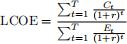
where Ct is annual cost and Et is electricity generated.
2. Interpret your result: Is this project competitive with fossil fuels ($50–$70/MWh)?
Part 3: Optimal Dispatch Problem
Three generators (A, B, C) offer to supply electricity at the following costs:
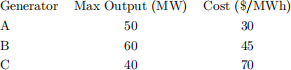
Total demand is 120 MW.
1. Determine which generators are dispatched and how much each produces.
2. What is the market-clearing price (LMP)?
3. What if transmission limits prevent generator C from delivering more than 20 MW?
Part 4: LCOE vs. LACE
A 50 MW wind project produces 150,000 MWh/year and avoids $6 million/year in fossil generation costs.
• Lifetime: 20 years
• Discount rate: 5%
• LCOE: $40/MWh
1. Calculate the Levelized Avoided Cost of Energy (LACE):

2. Compare LCOE to LACE. Should this project be pursued?
Part 5: Nuclear Economics
A nuclear plant has the following characteristics:
• Capital cost: $10 billion
• Fixed O&M: $200 million/year
• Fuel cost: $100 million/year
• Capacity: 1,000 MW; Capacity factor: 90%
• Lifetime: 40 years; Discount rate: 5%
1. Calculate annual generation.
2. Use the Capital Recovery Factor (CRF) formula to annualize capital costs:
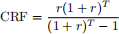
3. Compute total annual cost and LCOE.
4. Discuss cost competitiveness relative to wind and solar.
2026-01-17