Econ0002/95 Individual Writing Assignment
Hello, dear friend, you can consult us at any time if you have any questions, add WeChat: daixieit
Econ0002/95 Individual Writing Assignment (IWA)
Unemployment is more than lost wages—it fractures social cohesion, erodes human capital, and deepens inequality. While monetary costs are well-documented, this paper uncovers the invisible yet profound non-monetary costs—psychological distress, social exclusion, and skill erosion—that disproportional burden vulnerable demographic groups.
Anchored on the Labour Discipline and WS-PS models, alongside the EVS data, this analysis explores how these non-monetary costs perpetuate unemployment and proposed targeted interventions to disrupt this circle.
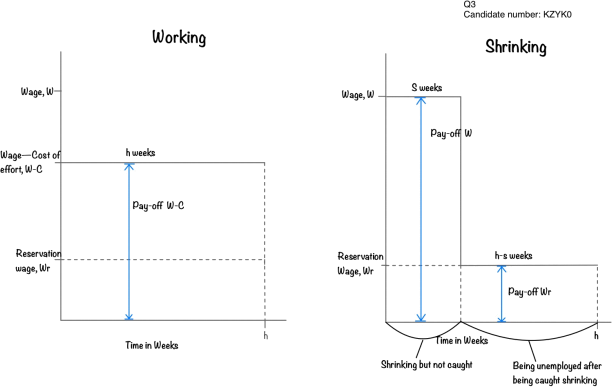
Figure1
The Labour Discipline Model explains how employment rent—wages above unemployment benefit(Figure1)—sustains productivity. Prolonged joblessness erodes this rent, triggering financial insecurity, risk aversion, and diminishing labor mobility. Older workers and low-income households, suffer lasting psychological strain and employability decline, examplified by JapanIs "lost decades"(Funabashi & Kushner, 2015). Non-monetary costs arenIt just side effects—they are structural barriers trapping individuals in long-term unemloyment.
Figure2
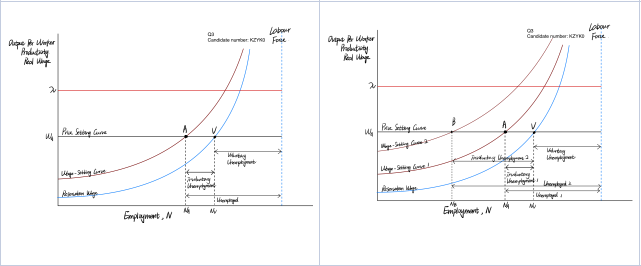
The WS-PS Model illustrates how firms set wages above the reservation level to maintain effort, causing involuntary unemployment.
Initially, social stigma compels job seekers into work, while prolonged unemployment inflates the non-shirking wage as skill erosion, declining work ethic, and lower motivation raise firmsI costs to sustain productivity. This shifts the Wage-setting curve upward, increasing equilibrium unemployment. Southern EuropeIs youth unemployment crisis(Reed, 1988)examplifies how these forces creates a self-reinforcing cycle of exclusion, particularly among young and low-skilled workers.
(EVS)data reveals that unemployed individuals report lower life satisfaction than employed counterparts, whereas retirees maintain stability. This stability stems from voluntary labor market withdrawal, which mitigates psychological distress, unlike involuntary that amplifies self-perceived work ethic(Figure3) as a coping mechanism driven by social pressure.
Paradoxically, this increased work ethic intensifies psychological strain without improving re- employment propspects.
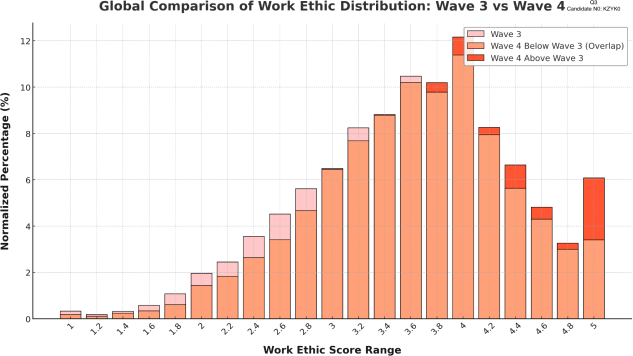
Figure3
Demographic Disparities
1. Gender Differences
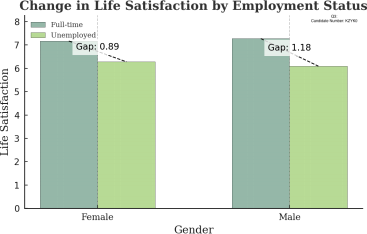
Figure4
Unemployment affects men and women differently due to varying well-being determinants and labour roles. Man experience a s harper decline in life satisfaction post-job loss, (1.18 vs. 0.89 for women;Figure4), as their self-worth is tightly linked to employment. Long-term unemployment often leads to apathy among men(Shostak,1972). Women, though more adpative, tend to remain engaged in domestic roles which provides a sense of stability but reinforces a long-term disadvantages.
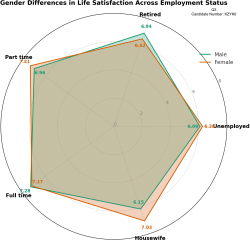
Figure5
(Van der Meer, 2014)finds that structural barriers hinder womenIs re-employment with 18.5% remaining in domestic roles compared to 15% of men(Figure 6)
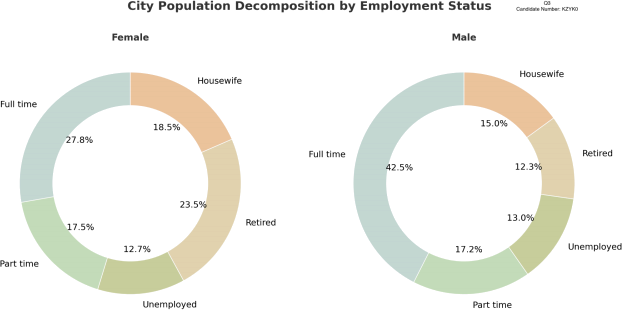
Figure 6
2. Age difference
Figure7
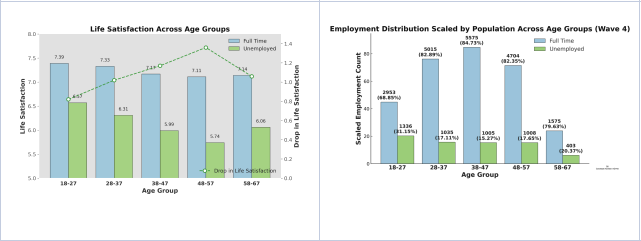
Unemployment Is non-monetary costs vary significantly across age groups.
Figure7---Young workers(18-27) face the highest unemployment rate(31.15%), due to entry barriers and skill mismatches. though options for further education mitigated distress (Ullah,1988). Middle-aged workers (48-57) exhibits lower unemployment rates(15.27%-17.65)but endure severe financial strain and household instability(Jackson & Warr, 1984). Older workers (57+) experience moderate unemployment rate(20.37%)and psychological strain but often face forced early retirement, leading to social isolation and financial insecurity(Ullah,1988).
Addressing these disparities demands precision. Youth retraining mitigates skill erosion. Financial safeguards stabilize mid-career households. Re-employment pathway combat exclusion. Without targeted action, non-monetary costs will escalate,reinforcing economic stagnation and inequality. A truly resilient economy doesnIt just reduce unemployment figures—it rebuilds opportunities.
Government must move beyond conventional labor policies, using data-driven interventions to break cycles of exclusion and inefficiency.
Bibliography
“ European Values Study Longitudinal Data File 1981-2008 (EVS 1981-2008) ” 2020. Data set. GESIS Data Archive, Cologne. https://doi.org/10.4232/1.13486. from
Funabashi, Yoichi, and Barak Kushner. 2015. Examining Japan’s Lost Decades.
https://doi.org/10.4324/9781315715223., from
https://api.taylorfrancis.com/content/books/mono/download?
identifierName=doi&identifierValue=10.4324/9781315715223&type=googlepdf
Reed, C. Y. 1988. “Youth Unemployment in the 1980s: Its Psychological Effects. By Michael H. Banks and Philip Ullah. London and Sydney: Croom Helm. 1988. 159 Pp. £22.50 ” The British Journal of
Psychiatry 153 (6): 868–69. https://doi.org/10.1192/s0007125000224884.from,
https://www.academia.edu/download/59874095/Chapter_Kogan_et_al.__final-120190626-53020- 1tk2en0.pdf
Van Der Meer, Peter H. 2012. “Gender, Unemployment and Subjective Well-Being: Why Being Unemployed Is Worse for Men than for Women.”
Social Indicators Research 115 (1): 23-44, https://doi.org/10.1007/s11205-012-0207-5 from
https://link.springer.com/content/pdf/10.1007/s11205-012-0207-5.pdf
S hostak, Arthur, Marie Jahoda, Paul F. Lazarsfeld, and Hans Zeisel. 1972. “Marienthal: The Sociography of an Unemployed Community.” Social Forces 50 (4): 550,
https://doi.org/10.2307/2576822. from
https://compress-pdf.bcad.info/?fileurl=https%3A%2F%2Fdl.vdoc.pub%2Fdownload-
file%2Fmarienthal-the-sociography-of-an-unemployed-community-
 36h4k4j8kccg%3Fhash%3Dbc5cfba77f6bedbcfa7e08a1eef72f12&title=Marienthal%3A+The+S
ociography+of+an+Unemployed+Community&utm_source=vdocpub&utm_medium=queue& utm_campaign=36h4k4j8kccg
Ullah, P. "Unemployment and psychological well-being." Modern Perspectives in Psychosocial Pathology. New York, Brunner/Mazel (1988): 247-267., from
https://archive.org/details/modernperspectiv0000unse_n3g1
Jackson, Paul R., and Peter B. Warr. “ Unemployment and Psychological Ill-Health: The Moderating Role of Duration and Age ” Psychological Medicine 14, no. 3 (1984): 605–14.
https://doi.org/10.1017/S003329170001521X. from
https://www.cambridge.org/core/services/aop-cambridge-
core/content/view/053F094D68042BEF1542CBCCEDC32DDF/S003329170001521Xa.pdf/une mployment-and-psychological-ill-health-the-moderating-role-of-duration-and-age.pdf
2025-12-20