Introduction to Cell and Molecular Biology Final Exam
Hello, dear friend, you can consult us at any time if you have any questions, add WeChat: daixieit
Final Exam
Introduction to Cell and Molecular Biology
MULTIPLE CHOICES
1) The variable part of an amino acid is called:
A. Amino Group
B. Carboxyl Group
C. Side Chain
D. Peptide Bond
2) Peptide bond forms between two:
a. Nucleotides
b. Amino acids
c. Carboxyl groups
d. Monomers of glucose
3) Alpha-helix and beta-sheet are stabilized together by:
a. Phosphodiester bonds
b. Ionic bonds
c. Peptide bonds
d. Hydrogen bonds
4) The DNA polymerase catalyzes the bond between:
a. Amino acids
b. Nucleotides
c. Glucose monomers
d. Lipids
5) When two different subunits in a protein interact together, they form a:
a. Primary structure
b. Secondary structure
c. Tertiary Structure
d. Quaternary Structure
6) Which of these sentences about the differences between Eukaryotes and Prokaryotes is true:
a. They both have a nucleus
b. Prokaryotic cells have Golgi apparatus.
c. Eukaryotic cells have a chloroplast
d. Prokaryotic cells have a vacuole
7) The hydrolysis of ATP produces:
a. ADP + Pi+ energy
b. GTP+ Pi+ energy
c. ADP + Ni + energy
d. ADP + Ci + energy
8) During DNA replication the______ untwists the double strand DNA (dsDNA) ?
A. RNA polymerase
B. ECORI
C. Topoisomerase
D. DNA polymerase I
9) In Eukaryotes, the DNA is found in the:
A. Nucleus
B. Vacuole
C. Cell membrane
D. Golgi
10) In prokaryotes transcription is initiated by the holoenzyme. Which is composed of:
A. RNA polymerase + gamma factor
B. RNA polymerase + holoefactor
C. DNA polymerase + sigma factor
D. RNA polymerase + sigma factor
11) Transcription factors only activate gene expression.
A. True
B. False
12) During the cell cycle the DNA is replicated during?
A. G1 phase
B. S phase
C. M phase
D. G2 phase
13) Multiple codons can codify for the same amino acid
A. True
B. False
14) A blood cell placed in a hypotonic solution will burst (lyse)
A. True
B. False
15) Which of the following has an endoplasmic reticulum (ER)?
A. An animal cell
B. A plant cell
C. A bacteria
D. A and B
16) The aminoacyl-tRNA synthetase___.
A. Catalyzes the bond between amino acid and tRNA
B. Catalyze the bond between amino acids
C. Catalyze the bond between nucleotides
D. Catalyze the formation of the ribosome
17) Transcription happens in the cytoplasm of eukaryotic and prokaryotic cells.
A. True
B. False
18) The RNA polymerase initiates the transcription of a gene by binding to the:
A. Transcription factor
B. Promoter
C. Regulatory module
D. Terminator
19) In the RNA the T (thymine) is substituted with the:
A. A (adenine)
B. G (guanine)
C. C (cytosine)
D. U (uracil)
20) Considering the chromosome below:
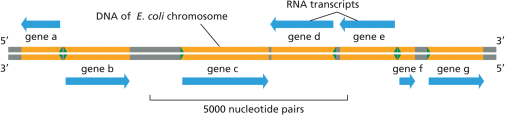
The sequence for the gene B is:
5’-ATG CTT GAC-3’
3’-TAC GAA CTG-5’
The mRNA for the gene B is:
A. 5’-TAC GAA CTG-3’
B. 5’-GTC AAC CAT-3’
C. 5’-AUG CUU CAG-3’
D. 5’-ATG CTT GAC-3’
21) How is the site of ribosome where the new polypeptide grows called?
A. P
B. A
C. E
D. R
22) DNA is compacted in chromosomes during:
A. S phase
B. G1 phase
C. G2 phase
D. M phase
23) During mitosis the chromosomes align along the longitudinal axes of the cell, called?
A. Telophase plate
B. Metaphase plate
C. Spindle body
D. Cytokinesis plate
24) During the cell cycle Cyclins fluctuate in concentration while Cyclin-dependent kinases (Cdks) do not:
A. True
B. False
25) When a GTP is bound to the G protein…
A. The G protein is in active state
B. The G protein is an inactive state
C. The G protein binds ATP not GTP
26) Which of the following reagents is not part of a PCR reaction?
A. DNA template
B. Primers
C. Ligase
D. Nucleotides (dNTPs)
27) Nucleosomes are made of.
A. DNA + histone proteins
B. DNA + RNA
C. RNA + Fatty acid
D. DNA + Transcription factors
28) Two DNA strands running in opposite direction are called?
A. Parallel
B. Antiparallel
C. Perpendicular
D. Orthogonal
29) The DNA polymerase has two important activities during DNA replication. These activities are (more than one answer):
A. Formation of the hydrogen bonds between the DNA strands
B. Proofreading the newly synthetized DNA strand
C. Formation of the phosphodiester bond between two nucleotides
D. Addition of the phosphate to the growing DNA strand
30) Which of the following statements is true in regard to plant and animals?
A. Plants and animals are composed of eubacterial cells
B. Plants and animals are composed of prokaryotic cells
C. Plants and animals are composed of eukaryotic cells
31) Which of the following organelles produces ATPs?
A. Mitochondria
B. Ribosomes
C. Golgi apparatus
D. Vacuole
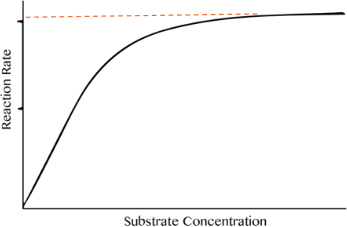
32) In a reaction rate vs. substrate concentration graph (see below), the rate of the reaction plateaus because:
A. There is no more substrate in the cell
B. The enzymes consumed all the energy in the cell
C. The enzymes are all saturated
D. The enzymes dissociate and they are sent to degradation
33) What does half of Vmax represent in enzyme kinetics?
A. The highest achievable rate of an enzymatic reaction
B. The rate at which the enzyme is completed saturated with the substrate
C. The rate at which the substrate concentration is represented by Km
D. The initial rate of reaction at zero substrate concentration
34) The Michaelis constant (Km) is:
A. Inversely related to affinity
B. Inversely related to the concentration of substrate
C. The substrate concentration at maximum velocity
D. All the above
35) The DNA polymerase catalyzes the new bond in direction?
A. 3’ to 5’
B. 5’ to 3’
C. Both ways
36) During a cloning process, the plasmid carrying the gene of interest is replicated by?
A. By doing PCR
B. By using restriction enzymes
C. By transforming bacteria cells
37) What is the function of GPCR in cell signaling?
A. Transmit signals across the cell membrane
B. Synthesize new proteins
C. Hydrolyze ATP
D. Store calcium ions
38) The DNA strand synthetized using Okazaki fragments is called?
A. Last strand
B. Leading strand
C. Lagging strand
D. Template strand
39) RNA polymerase and the DNA polymerase catalyze the same bond?
A. True
B. False
40) When different genes are organized in clusters with shared regulatory sequences is called
A. Monocistronic genes
B. Operon
C. Promoter
D. Operator
41) Transcription factors bind to a region called?
A. Exons
B. Trans-DNA sequences
C. Cis-regulatory modules
D. None of the above
42) External signals are often transduced inside the cell via a series of phosphorylation. Which kind of protein is phosphorylated to transduce the signal?
A. Phosphatase
B. Kinase
C. Polymerase
D. Topoisomerase
43) The material is transported in and out of the nucleus through____ in the nuclear envelope
A. Molecular motors
B. Flippase proteins
C. Vesicles forming
D. Pores
44) The Rough Endoplasmic Reticulum is described as “rough” because:
A. It makes the largest proteins of the cell
B. It has microvilli that give it a textured appearance
C. It is studded with ribosomes
D. The word “rough” is a historical term with no biological significance
45) The sugar molecule present in the RNA is:
A. Glucose
B. Ribose
C. Fructose
D. Galactose
46) Guanine always base pairs with :
A. Cytosine
B. Thymine
C. Adenine
D. Uracil
47) Which ribosome subunit is the site for mRNA binding:
A. Large
B. Small
48) A ribosome is made of two subunits, one large and one small.
A. True
B. False
49) The RNA polymerase needs a primer to start the transcription process
A. True
B. False
50) Which is the first codon transcribed by the RNA polymerase?
A. ATT
B. ACU
C. ATG
D. AUG
51) The cytoplasm divides in two and new membranes (and walls) are formed during:
A. Telophase
B. Metaphase
C. Prophase
D. Cytokinesis
52) During translation the primers place on the DNA template by the DNA primase are made of
A. RNA
B. DNA
C. Amino acids
53) Interphase is composed of:
A. G1, S, G2
B. M, G1, S
C. S, G2, M
54) DNA content is reduced during the process of
A. Mitosis
B. Meiosis
55) Which of those types of cells permanently exit the cell cycle
A. Stem Cells
B. Neurons
C. None of above
56) The initiation of DNA replication happens in a place of the genome called:
A. Replication bubble
B. Origin of Replication
C. Okazaki position
D. Termination
57) The spindle is formed of filament made of:
A. Microtubules
B. Macrofilaments
C. Collagen
D. Myosin
58) Which factor determines the arrest of translation:
A. Termination Factor
B. Sigma Factor
C. Release Factor
D. Stop Factor
59) Environmental signals can modulate the expression of genes.
A. True
B. False
2025-12-20