Econ 11 Final
Hello, dear friend, you can consult us at any time if you have any questions, add WeChat: daixieit
Econ 11 Final
June 11, 2025
Exam Rules
1. The exam starts at 3:00 and ends at 6:00.
2. There are 6 short answer questions worth 15 points each and 3 long questions worth 60 points each. The last 30 points will come from completing course evaluations (15 points) and the post-final surveys (15 points) for a total of 300 points.
3. Calculators are allowed, including graphing calculators.
4. You may use one double-sided 8.5x11 sheet of paper with notes as a cheat sheet.
5. Please put all materials other than your calculator, cheat sheet, and a pen or pencil in your bag. If you have a phone or other item out for any reason you will be given a 0 on the exam.
6. You must SHOW ALL WORK. No credit will be given for an answer with no work. You may leave an answer unsimplified, but be clear about the steps you took to get there so the graders can easily see if it’s correct
Short Questions (15 Points Each)
1. Joe receives utility from almonds (A) and cashews (C) based on the function U = 3A + 4C. Joe is currently consuming 4 almonds and 3 cashews. Plot an indifference curve that goes through this point. Using your graph, explain whether Joe would be willing to trade 2 almonds for 2 cashews. You may refer to the utility function in your answer, but your primary explanation must be based on your graph.
2. A consumer has a utility function given by U = x3 + 4y3 . If the price of x is 1 and the price of y is 4, what is the maximum utility this consumer can achieve with an income of 20?
3. A consumer has an expenditure function given by  Initially the price of x is $4 and the price of y is $9 and the consumer reaches a maximum utility of 6. The government is considering 2 taxes. The first option is a $5 per unit tax on each unit of x purchased and the second is a one time $12 lump sum tax. Which would the consumer prefer? Explain.
4. A firm has an MRTS (MPL/MPK) of 1/5 for any quantity of capital and labor. If it decreases labor by 1 and increases capital by 3, will it increase or decrease its output? Explain.
5. A firm in a perfectly competitive market has a cost function given by
C = Q3 − 12Q2 + 60Q + 100
Would it ever be optimal for this firm to produce a quantity of 5? If so, find the price that makes this quantity the profit maximizing choice of the firm. If not, explain why not.
6. Consumers A and B have strictly positive endowments of x and y and at these en-dowments have MRS of MRSA = 5 and MRSB = 2. In equilibrium, would each consumer increase or decrease their consumption of x and y compared to their initial endowment? Provide the smallest possible range of potential equilibrium prices given the information provided. Explain.
Long Questions
1. Assume there are 60 firms in the market for x that have production functions given by

(a) (15 points) Assume that each firm wants to produce a quantity of 80 units. If the market wage is 16 and the market rental rate is 4, how much labor and capital would each firm choose in order to produce its desired quantity in the cheapest possible way?
(b) (15 points) Assume that the firm now has a fixed capital equal to the value you found in part (a). Calculate each firm’s short run supply curve (assume the same wage and rental rate as above) and the market supply curve (remember there are 60 firms).
(c) (15 points) Now assume there are 1600 consumers with an income of $80 each and that each have utility function given by
U(x, y) = 3 ln(x) + 5 ln(y)
Derive the individual and market demand for x for this economy. You do not need to setup a Lagrangian but must show all other steps. Given the market demand curve and market supply from part (b), what is the equilibrium price?
(d) (15 points) Based on the equilibrium you found in part (c), would there be entry or exit of firms into the market for x? What is the long run equilibrium price? How many firms would operate in this market in the long run?
2. There are two consumers (A and B) in an economy that each have the same utility function
U(x, y) = 250 ln(x) + y
but different endowments of x and y
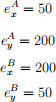
(a) (15 points) Assume that consumers can buy and sell x and y at px = 5 and py = 1. Calculate each consumer’s optimal consumption of x and y given these prices (you do not need to setup a Lagrangian but must show all other steps). Based on these answers, is the equilibrium price ratio above, below, or equal to 5? Explain.
(b) (15 points) Repeat part (a) assuming px = 1 and py = 2 (Hint: make sure your answer makes sense economically).
(c) (15 points) Calculate the equilibrium price ratio and allocation of x and y for each consumer given the initial endowments.
(d) (15 points) Consumer A’s endowment of y drops to  Will the equilibrium price ratio increase or decrease. Explain how you know without referencing the actual equilibrium price (5 points). Calculate the exact equilibrium price and allocation of x and y for each consumer (10 points).
3. Consumers get utility from pillows (P) and blankets (B) according to the following utility function
U = min(P, 4B)
(a) (15 points) Calculate the consumer’s Marshallian demand for pillows and blankets as a function of prices and income. Show all steps in deriving your answer.
Now assume that a single firm produces pillows and blankets according to the following production functions

They hire labor to work for  hours.
(b) (15 points) Derive the firm’s Production Possibility Frontier (PPF) and Rate of Product Transformation (RPT) based on this information.
(c) (15 points) Assume that the price of each pillow is pP = 1 and price of each blanket is pB = 2. How much would the firm in part (b) produce given these prices? If the consumers received income equal to the firm’s revenue how much would they consume? Based only on these answers, would the equilibrium price ratio be above, below or equal to 
(d) (15 points) Calculate the equilibrium price ratio and quantity of pillows and blan-kets produced and consumed. Compare these values to the consumption and production in part (c). Did they go up or down? Explain the intuition.
2025-12-13
Microeconomic theory