BENV0058 Lighting Fundamentals 2025-2026
Hello, dear friend, you can consult us at any time if you have any questions, add WeChat: daixieit
BENV0058 Lighting Fundamentals 2025-2026
Coursework: Lighting Assessment and Design Exercise
The objective of this coursework is for you to develop daylight and electric lighting assessment and basic design skills. You are asked to prepare a report covering the lighting in a two-person office.
Throughout this coursework, please state all the assumptions that you make.
The Room
This study relates to the lighting in a cellular office room in London (Lat: 51.5267, Lon: -0.1298). The room is used as a two-person office and is occupied most weekdays from 08:00 in the morning to 18:00 in the evening. Details of the room are given on the room details sheet.
Daylight in the Room
To assess the daylight availability in the room, build a grid of points following EN 17037 recommendations and manually calculate the percentage of the working plane with an illuminance from daylight of at least:
a) 100 lux
b) 300 lux
c) 500 lux
over at least half of daylight hours in a year. In the manual calculations, you may use relevant methods described in BRE Digests 309 and 310.
Interpret the results to assess the daylight availability in the room.
Sunlight in the Room
Check to see how many hours of sunlight the room can receive on 21st March. Interpret the results to assess the sunlight availability in the room.
Electric Lighting Design
Use utilisation factors to calculate the number of each type of luminaire necessary to meet the requirements of the SLL Code for Lighting. Select the luminaire type that is best for the room and check your design for the chosen luminaire type using DIALux. Details of the luminaires are given in the datasheets included at the end of this document.
Lighting Controls
Develop a lighting control strategy for the room and explain the advantages ofthe controls used in terms of user comfort and energy saving.
Also estimate the energy saving for electric lighting that could be achieved through the use of the proposed lighting controls.
Method Review
Consider the methods that you have used in the sections above and comment on their accuracy and any assumptions that they depend on. Expand on limitations of the methods and assumptions used and discuss what you would recommend for further improvements to the lighting of the space.
Additionally, reflect on what you might have done differently or included in the assessment, and explain how you would have implemented those changes.
Submission
Submit your report as a PDF document to the BENV0058 Lighting Fundamentals Moodle webpage by 11:00 (GMT) on 09/12/2025. The document should be clearly set out and have no more than 3,000 words (excluding annexes). Working should be shown either in the main text or an annex.
Standard penalties may be applied to overlength or late submissions.
Marking Schedule
Marks will be awarded as follows:
|
Topic |
Marks |
|
Daylight in the Room |
20 |
|
Sunlight in the Room |
10 |
|
Electric Lighting Design |
20 |
|
Lighting Controls |
20 |
|
Method Review |
20 |
|
Presentation |
10 |
The coursework total mark will constitute 100% of the module mark.
References
The following publications may be useful in completing this coursework:
• BRE (1986). BRE Digest 309 Estimating daylight in buildings: Part 1. Watford: Building Research Establishment.
• BRE (1986). BRE Digest 310 Estimating daylight in buildings: Part 2. Watford: Building Research Establishment.
• BSI (2017). BS EN 15193-1 Energy performance of buildings. Energy requirements for lighting. Specifications, Module M9. London: British Standards Institution.
• BSI (2019). BS EN 17037 Daylight in buildings. London: British Standards Institution.
• BSI (2021). BS EN 12464-1 Light and lighting. Lighting of workplaces. Indoor workplaces. London: British Standards Institution.
• SLL (2022). The SLL Code for Lighting. London: Society of Light and Lighting.
In addition to the publications listed above, please consult the lecture handouts and workshop materials discussed during the module. You should also refer to the additional sources provided on the Moodle module page for specific sessions, as well as the contents ofthe ‘Tools’ folder under the Fundamentals Coursework section.
For any clarifying questions regarding the coursework brief or specific tasks, please contact the module leader at c.ticleanu@ucl.ac.uk
Room Information
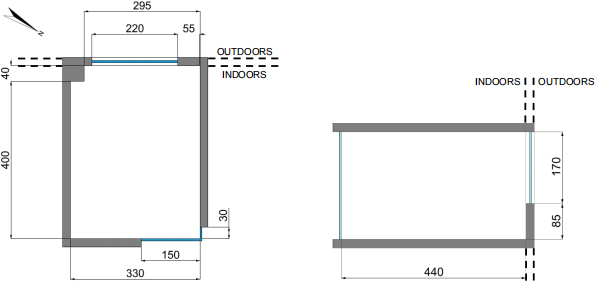
The room faces 58° west of south. The plan below (left hand image) gives the layout and size of the room, and the section below (right hand image) gives the height of the window and windowsill (all dimensions are given in centimetres):
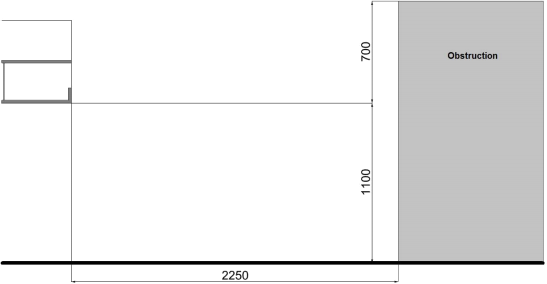
The view out of the window is obstructed by a building on the other side of the road. The following diagram shows the geometry of the situation (all dimensions are given in centimetres):
The room surfaces have the following reflectances:
• Ceiling: 0.80
• Walls: 0.60
• Floor: 0.20
• Glazing: 0.10
Other given parameters are as follows:
• Diffuse transmittance for window glazing: 0.70 (double glazing)
• Thickness of walls: 0.20m
• Working plane height: 0.85m
• The working plane should be considered over the entire room area (no wall offset)
2025-11-12
Lighting Assessment and Design Exercise