Physics 2: Physical Science & Technology (PHYC10004) Week 3
Hello, dear friend, you can consult us at any time if you have any questions, add WeChat: daixieit
Physics 2: Physical Science & Technology (PHYC10004)
Week 3
Discussion questions
1
(a) A piece of paper is folded into three portions of equal area as shown in the diagram.
How many area vectors are needed to describe the surface of the paper? Sketch the area vectors on the side view diagram and label them A1, A2, etc.
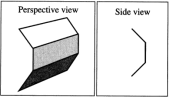
(b) Consider an imaginary surface in a uniform electric field E as shown. The surface has the same size and shape as the paper above. Is the flux through the top third of the surface greater than, less than, or equal to the flux through the middle third? Explain.
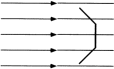
(c) Write an expression for the net electric flux Φnet through the surface in terms of the area vectors and the electric field E.
Reproduced from Tutorials in Introductory Physics, LC McDermott et al. © Prentice-Hall 2002
2
A closed Gaussian surface consists of a hemispherical surface and a flat plane as shown. A point charge +q is placed outside the surface, and no charge is enclosed by the surface.

(a) State the flux through the entire closed surface. Explain.
(b) Let ΦL represent the flux through the flat left-hand portion of the surface. Write an expression in terms of ΦL for the flux through the curved portion of the surface, ΦC.
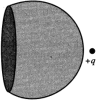
(c) Suppose that the curved portion of the Gaussian surface in part (a) is replaced by the larger curved surface as shown. The flat left-hand portion of the surface is unchanged.
(i) Does the value of ΦL change? Explain.
(ii) How does the flux through the new curved portion of the surface
compare to the flux through the original curved portion of the surface? Explain.
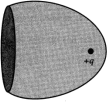
(d) Suppose that the curved portion of the Gaussian surface is replaced by a larger curved surface that encloses the charge as shown in the picture at right. The flat left-hand portion of the surface is still unchanged.
(i) Does the value of ΦL change? Explain.
(ii) How does the flux through the new curved portion of the surface compare to the flux through the original curved portion of the surface? Explain.
(iii) Use Gauss’ law to write an expression in terms of ΦL and q for the flux through the curved portion of the surface.
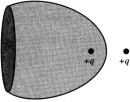
(e) A second point charge +q is placed to the right of the Gaussian surface as shown.
(i) Is the value of ΦL greater than, less than, or equal to the value of ΦL in part (c)? Explain.
(ii) Is the value of the flux through the entire Gaussian surface greater than, less than, or equal to the value of the flux through the entire Gaussian surface in part (d)? Explain.
Reproduced from Tutorials in Introductory Physics, LC McDermott et al. © Prentice-Hall 2002
3
A solid, spherical conductor is given a non-zero net charge. Which one of the following statements is true: The electrostatic potential of the conductor is
a) largest at the centre b) largest on surface
c) largest somewhere between centre and surface d) constant throughout volume
Problem-solving questions
4
A point charge of 1.8 µC is at the centre of a cubical Gaussian surface with a 55 cm edge. What is the net electric flux through one side of the cubical surface?
5
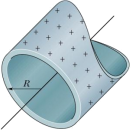
The figure shows a section of a long, thin- walled metal (conducting) tube of radius R with a charge per unit length = λ C/m on its surface. Derive expressions for E in terms of the distance r from the tube axis, considering both
(a) r > R, and
(b) r < R. Plot your results for the range r = 0 to r = 5.0 cm, assuming that λ = 2.0 × 10⁻⁸ C/m and R = 3.0 cm.
6
A point charge +q is placed at the centre of an electrically neutral, spherical conducting shell with inner radius a and outer radius b.
What charge appears on (a) the inner and (b) the outer surfaces ofthe shell?
What is the net electric field at a distance r from the centre of the shell if
(c) r < a
(d) b > r > a, and
(e) r > b?
Sketch field lines for those three regions.
For r > b what is the net electric field due to
(f) the central point charge,
(g) the inner surface charge and (h) the outer surface charge?
Q 3, 4 & 5 From Fundamentals of Physics, 7/e, Resnick, Halliday and Walker, © John Wiley 2005. Reproduced with permission.

7
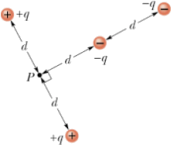
From the figure below, calculate the net potential at point P due to the four point charges. Take V = 0 at infinity, q = 5.00 fC and d = 4.00 cm? (fC = 10-15 C)
From Fundamentals of Physics, 7/e, Resnick, Halliday and Walker, © John Wiley 2001. Reproduced with permission.
8 (mini-challenge)
Two charges are placed on the x-axis as shown in the diagram below.
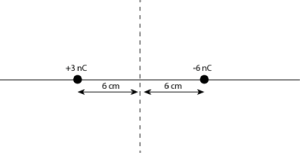
(a) Find any points of zero potential anywhere on the x-axis.
(b) Do these points (if any) correspond with points of zero electric field on the x-axis?
(c) Are there any points off the x-axis where the potential is zero?
(d) Are there any equipotential lines (lines of equal potential) in the x-y plane? (qualitative answer only)
Past examination questions
9
(a) Consider the closed surface of the cube where one of the surfaces is labelled A. An electric charge +q is located outside the cube as shown in the figure.
(i) What is the total electric flux through the entire surface of the cube? Explain.
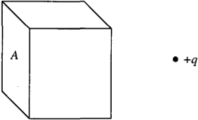
Suppose the cube is extended so that it is now a rectangular prism and it completely encloses the charge q. The position of the surface A relative to the charge is unchanged.
(ii) Does the value of the flux through surface A, denoted ΦA, change? Explain.
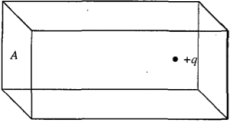
(iii) Use Gauss’ law to write an expression in terms of ΦA and q for the flux through the remainder of the surface.
(b) A large flat conducting sheet carries a surface charge density of +σ C/m2 across its
total surface. Using Gauss’ law, determine an expression for the magnitude and direction of the electric field near the surface of the conducting sheet. Carefully explain all the stages of your calculation.
10
Consider two concentric conducting spheres (as shown in the figure). The outer sphere is hollow, with an inner radius of b and an outer radius ofa, and initially given a charge of -7Q. The inner sphere is solid, and has a radius of c, and has a charge of +2Q on it.
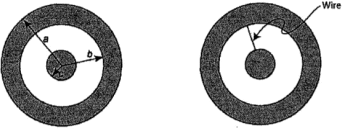
(i) Explain why the electromagnetic field inside the conducting regions, b < r < a and r < c, must be zero, where r is the distance from the centre of the inner sphere.
(ii) Using Gauss’ law, find the total charge lying on the inner surface of the hollow conductor (i.e. at r = b).
(iii) How much charge lies on the outer surface of the hollow conductor (i.e. at r = a)?
(iv) Using Gauss’ law, find an expression for the electric field outside the spherical shell, i.e. for r > a. Explain all steps in your derivation
[Hint: the surface area of a sphere of radius R is 4πR2.]
Suppose a conducting wire is then connected between the inner and outer spheres, as in the figure on the right.
(v) After electrostatic equilibrium is reached, how much total charge is on the outside sphere?
(vi) How much charge now lies on the inner surface of the hollow conductor?
(vii) How much charge now lies on the outer surface of the hollow conductor?

2025-11-12