Physics 2: Physical Science & Technology (PHYC10004) Week 2
Hello, dear friend, you can consult us at any time if you have any questions, add WeChat: daixieit
Physics 2: Physical Science & Technology (PHYC10004)
Week 2
Discussion Questions
1
Two identical metal balls are suspended by equal length insulating strings. Both balls have the same net charge. In this problem, do not assume the balls are point charges.
(a) Draw separate free-body diagrams for each ball. Label the forces to indicate:
• The object exerting the force,
• The object on which the force is exerted
• The type of force (gravitational, normal, friction, etc.)
(b) Predict what will happen if the charge on the second ball is reduced slightly, so it is less than that on the first ball. Draw a sketch to illustrate your answer.
Is the angle that ball 1 makes with the vertical, greater than, less than, or equal to the angle that ball 2 makes with the vertical? Explain your reasoning.
(c) Predict what will happen if the net charge on the second ball is reduced to zero. Draw a sketch to illustrate your answer.
2
A charged acrylic rod and a small ball (a test charge) carries a charge qtest of the same sign as the charge on the rod. (The rod should be considered to be ‘long’ – remember, electric fields from an ~infinite rod are different to from a point charge) The top view figure shows 8 locations where the ball will be placed, marked with an ‘x’.
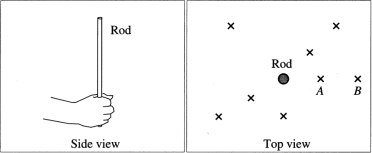
Reproduced from Tutorials in Introductory Physics, LC McDermott et al. © Prentice-Hall 2002
(a) Sketch vectors at each of the eight marked points to represent the electric force on the ball at that point.
(b) How does the magnitude of the force exerted on the ball at point A compare to the magnitude of the force on the ball at point B? (Take distances from the diagram.)
(c) Suppose that the charge, qtest on the ball were halved, while the charge on the rod remained unchanged. Would the electric force on the ball at each point change? If so, how? If not, explain why not.
(d) Would the magnitude or the direction of the electric field at point A change if:
• The charge on the rod were increased? Explain.
• The magnitude of the charge on the ball were increased? Explain.
• The sign of the charge on the ball were changed? Explain.
Problem-solving Questions
3
A point charge (+3.00 × 10⁻⁶C) is 12.0 cm from a second point charge (–1.50 × 10⁻⁶ C). Find the magnitude and direction of the force on each charge. Show the direction on a diagram.
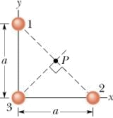
Find an expression for the magnitude and direction of the net electric field at P.
5 (mini-challenge question)
The diagram shows a non-conducting rod of length L has charge -q uniformly distributed along its length.

(a) State the linear charge density ofthe rod (include units).
(b) Calculate the electric field at point P, a distance a from the end ofthe rod. NOTE an integration is required. (Hint: use Coulomb’s Law for every charge element dq length dL)
(c) If P were very far from the rod compared to L (a >>L), the rod would look like a point charge. Show that your answer to (b) reduces to the electric field of a point charge in this case
Q 3, 4 &5 reproduced with permission from Fundamentals of Physics, 7/e, Resnick, Halliday and Walker, © John Wiley 2005.
Past exam questions
6
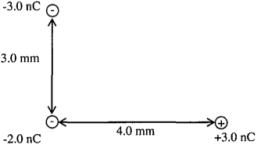
(a) Two point particles carry charges of +3.0 nC and -2.0 nC and are separated by a distance of 4.0 mm.

(i) What is the magnitude and direction of the force on the positive charge caused by the negative charge?
(ii) What is the magnitude and direction of the force on the negative charge caused by the positive charge?
(iii) A third charge of -3.0 nC is placed a distance of 3.0 mm from the negative charge as
shown in the figure. The three charges form the corners ofa right-angled triangle. What is the net force on the charge +3.0 nC due to the other two charges?
(b) When a plastic comb is rubbed with wool, the comb becomes negatively charged. It is
observed that small particles such as dust carrying no net charge are attracted to the comb. In one to two pages, using diagrams where appropriate, explain why this happens. In your answer you should address the following points:
• Why does the plastic comb become charged?
• How is the charge distribution within the electrically neutral particles affected by the electric field of the comb?
• Why are electrically neutral particles attracted to the comb?
• Why is it important that the field produced by the comb is not uniform for the neutral particles to be attracted to the comb?
7
(a) A glass rod is charged to +5 nC by rubbing.
(i) Have electrons been removed from the rod or protons added?
(ii) How many particles have been removed or added?
(b) A small charged particle (A) experiences an electrostatic force of magnitude 5 × 10⁻²N toward a small particle carrying a charge of +5.0 rC which is a distance of 10.0 cm from it. Given that there are no other charged particles in the vicinity of these two, what is the charge carried by the particle A?

(c) Consider two charges lying on the x-axis as shown in the figure. A charge of -2.50 rC
(charge A) is located at x = 0.00 m and a charge of +6.00 rC (charge B) is at x = +1.00 m.
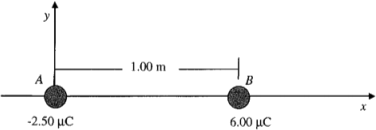
(i) What is the direction of the electric field in the region between the two particles, A and B?
(ii) What is the direction of the electric field on the x-axis to the right of particle B?
(iii) What is the direction of the electric field on the x-axis to the left of particle A?
(iv) Determine the point on the x-axis (other than at infinity) at which the electric field is zero.
2025-11-12