PHYC10004 sample questions
Hello, dear friend, you can consult us at any time if you have any questions, add WeChat: daixieit
PHYC10004 sample questions
Question 1 - Laws and Principles 10 marks
a) Electric flux is given by ΦE = EA cos θ . Sum this flux over the surface of a sphere of radius r around a point charge Q. Use Gauss’s Law to derive Coulomb’s Law for the electric field of a point charge. Explain your working and assumptions.
[Hint: Cos θ = 1 if the electric field is normal to the surface.]
b) Ampère’s Law involves a different sum over a closed loop. Use Ampère’s Law to calculate the magnetic field around a long straight wire carrying current i. Show all your steps and assumptions. What is the direction of the field?
c) Engineers and scientists often define the electric potential of Earth’s surface (‘ground’) to be zero. If they instead defined it to be +100 V, what effect would the change have on measured values of electric potentials and potential differences?
[ 4 + 4 + 2 = 10 marks ]
Question 2 - Survival Training (Die Another Day) 10 marks
(a) Advice sometimes given to mountaineers caught in lightning and thunderstorms is to: (i) move rapidly off peaks and ridges; (ii) stand with both feet close together; (iii) crouch down if you are in the open; and (iv) make sure that only your feet are touching the ground. Explain whether each piece of advice is good or bad, and why.
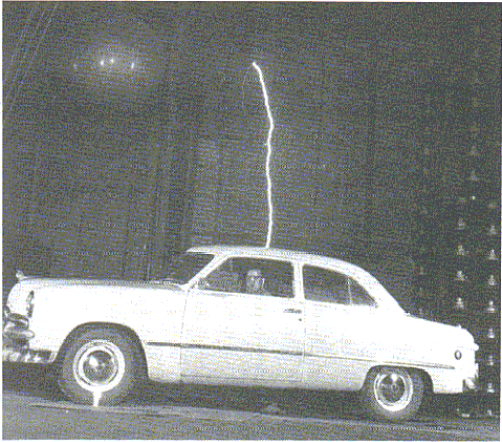
(b) The following picture shows a quite terrifying situation. An arc with a large current of one Ampere has just struck the car. Explain what happens to the passenger and why.
[ 8 + 2 = 10 marks ]
Question 3 - Loops 7 marks
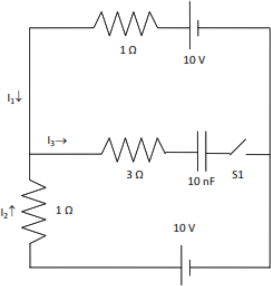
Use Kirchoff’s rules as necessary to consider the circuit in the box below:
(a) If switch S1 is open, what is the relation between the currect I1 and I2? What is the relation when switch S1 is closed? [Hint: use the loop rule.]
(b) What current I3 will flow when S1 is closed?
(c) After a long time, how much charge will have accumulated on the capacitor? What will I3 be then?
[ 3 + 3 + 1 = 7 marks]
Question 4 - lnteractivity 7 marks
(a) A lecture demonstration showed a student touching a high voltage generator and her hair standing on end. What caused the hair to stand on end? Explain, using electrical concepts.
(b) A related demonstration showed large electrical arcs from the dome of the high voltage generator to a ball that was held about 10 cm away. However, the student’s hands were touching the dome of the high voltage generator and she was not injured. Explain both of these observations.
(c) In another lecture demonstration, a gadolinium magnet was attracted to a permanent magnet. The experiment investigated how to demagnetise the gadolinium magnet by heating it with a light bulb. What happened after the magnet was heated? Describe a different method for demagnetising a [ferro-]magnet and explain why the magnet becomes demagnetised, with reference to the magnetic domains in the material.
[2 + 2 + 3 = 7 marks]
Question 5 - Camp Fire 5 marks
A camp fire of temperature 900 K produces a “yellowish” light. In contrast the Sun produces a much “whiter” spectrum of light. However, both objects can be modelled as black body radiators.
a) Sketch the blackbody emission spectrum of the sun and the campfire. Ensure that you label your axes and highlight the key points of difference.
b) Assuming the radiating part of the fire has an area of approximately 10-1 m2 , estimate the power output of the fire. Outline any assumptions you have made in your calculation.
[3 + 2 = 5 marks]
Question 6 - Looking Through A Glass Onion 5 marks
A neutral He atom consists of six particles: 2 electrons, 2 protons and 2 neutrons. The experimental measurements and theoretical calculations suggest that the root-mean-square charge radius of a proton is approximately 0.88 fm. [1 fm = 10−15 m.] Other experiments conclude that the neutron has a similar radius.
a) Complete the table below by identifying the forces in this atom as experienced by these six particles, including their relative magnitudes and range.
|
|
b) Estimate the diameter of the helium nucleus. Outline any assumptions that you have made.
[ 3 + 2 = 5 marks ]
Question 7 - Mad about Atoms 6 marks
The Balmer, Lyman, and Paschen series are specific series of spectral lines in the hydrogen atom that correspond to electron transitions between different energy levels. These series are part of the broader phenomenon of atomic emission spectra.
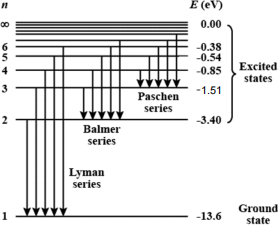
(a) For each of the Lyman, Balmer, and Paschen series in the hydrogen atom identify if the emitted photons are in the ultraviolet, visible, or infrared range of the EM spectrum.
The figure shows the ionization energy i.e. the energy required to remove the least strongly bound electron for the several light elements and the noble gases.
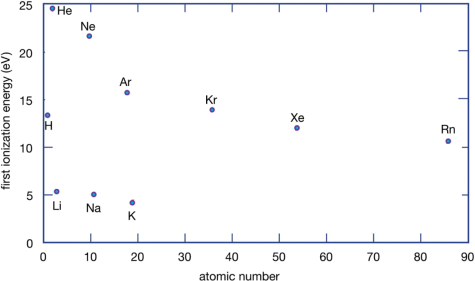
(b) Explain why the binding energy for Potassium (K) is similar to Sodium (Na) yet so much smaller in comparison to Argon (Ar).
[4 + 2 = 6 marks ]
Question 8 - Shine Bright Like A Diamond 8 marks
Sophia is conducting an experiment to determine the wavelength of X-rays emitted by a specific X- ray tube (as shown in figure below). She sets up a diffraction experiment using a crystal with known lattice spacing d = 0.2 nm and shines X-rays onto the crystal at a certain angle. By scanning the angles, Sophia observes a diffraction peak at an angle of 2θ = 30° for this particular crystal.
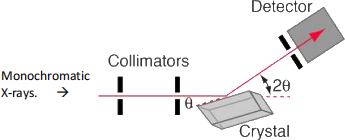
a) With the help of a diagram, explain the basic principle of how X-ray diffraction leads to the formation of these peaks in intensity of scattered x-rays. Show how it can be used to determine the wavelength of X-rays.
b) Calculate the wavelength of the X-rays using Bragg's law.
The beam of x-rays is now directed onto a thin powder metal target as shown, and the distribution of the scattered x-rays recorded on a photographic plate. A beam of electrons of a suitable energy is then directed onto the same target instead of the x-rays. The separate images recorded on the film using the x-rays and the electrons recorded are shown below. As can be observed, the two diffraction images have almost identical features.
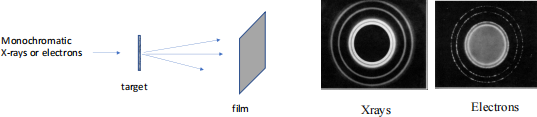
c) What conclusion can be drawn from the similarity of the scattered x-ray and electron images?
[ 3 + 3 + 2 = 8 marks ]
2025-11-12