EECS 492 Fall 2024: Midterm Exam
Hello, dear friend, you can consult us at any time if you have any questions, add WeChat: daixieit
EECS 492 Fall 2024: Midterm Exam
Section 1 (Problems 1 – 3)
Consider the graph below.
• Suppose A is the initial state, and Z the goal state.
• Note that the graph is directed (e.g., we can go from A to C, but not from C to A).
• Make any arbitrary choices as directed on p. 3.
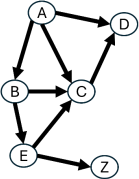
1) (6 points) Pick one: In BFS (graph search), what is the order in which states would be expanded?
A) ○ A B C D E
B) ○ A B C D E Z
C) ○ A B C D C E D
D) ○ A B C D E C D Z
E) ○ A B C D C E D C Z
2) (6 points) Pick one: In BFS (graph search), what is the greatest number of states on the frontier at one time?
A) ○ 1
B) ○ 2
C) ○ 3
D) ○ 4
E) ○ 5
Continuing with the same graph and instructions as the previous page, repeated here:
• Suppose A is the initial state, and Z the goal state.
• Note that the graph is directed (e.g., we can go from A to C, but not from C to A).
• Make any arbitrary choices as directed on p. 3.
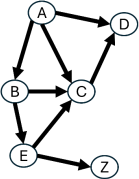
3) (9 points) Pick one: In DFS (tree-like search), what is the order in which states would be removed from the frontier?
A) ○ A B E Z
B) ○ A B C D E Z
C) ○ A D C B E Z
D) ○ A D C B E C D Z
E) ○ A B C D E C D Z
Section 2 (Problems 4 – 6)
Consider the graph below.
• Suppose A is the initial state, and Z the goal state.
• Note that the graph is undirected (in
contrast to the previous provided graph).
• Make any arbitrary choices as directed on p. 3.
• We’ll use the special notation for a node as described on p. 3.
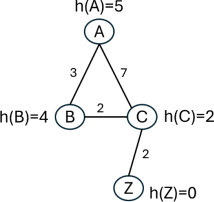
4) (3 points) Pick one: Consider UCS (graph search). Suppose you expand Ato get the frontier:
AB3 AC7
Show the frontier resulting from the next expansion.
A) ○ ABC5 AC7
B) ○ ABC5 ACZ8
C) ○ ABC5 ABA6 AC7
D) ○ AC7 ABA6 ABC5
5) (3 points) True or False: A* with heuristic h above will find the cost-optimal solution.
A) ○ True
B) ○ False
6) (3 points) True or False: A* with heuristic h above will perform in an optimally efficient manner.
A) ○ True
B) ○ False
Section 3 (Problems 7 – 10)
Answer the following about breadth-first search
(not to be confused with “best-first search with a FIFO queue”).
7) (3 points) Pick one: Which of the following best describes the goal test?
|
A) ○ |
Early goal test, because when the goal is first reached, a path with fewer steps will never be found. |
|
B) ○ |
Early goal test, because when the goal is first reached, a path with lower path cost will never be found. |
|
C) ○ |
Late goal test, because a path with lower path cost may be found later in the search. |
|
D) ○ |
Late goal test, because a path with fewer steps may be found later in the search. |
8) (3 points) Pick one: Which of the following best describes the ideal reached data structure implementation?
|
A) ○ |
It is a map of state:correspondingNode entries. |
|
B) ○ |
It is a map of state:parentState entries. |
|
C) ○ |
It is a map of state:pathCostToState entries. |
|
D) ○ |
It is a set of states. |
|
E) ○ |
It is a set of nodes. |
9) (3 points) Pick one: When a solution node is returned, how can the corresponding path from initial state to goal be generated?
|
A) ○ |
The reached structure contains parent information that can be followed backwards to the root of the search tree. |
|
B) ○ |
The node contains a parent node, which contains its parent node, and so on, to the root of the search tree. |
|
C) ○ |
The path is the reverse of the order in which nodes were removed from the frontier structure. |
|
D) ○ |
The path is the reverse of the order in which nodes were most recently added to the reached structure. |
10) (3 points) Pick one: Suppose we were to implement the BFS frontier as a priority queue that selects the item with lowest f-cost. What must f(n) be?
|
A) ○ |
f(n) = depth(n) |
|
B) ○ |
f(n) = -depth(n) |
|
C) ○ |
f(n) = h(n), where h(n) is a heuristic estimate of the cost to the goal |
|
D) ○ |
f(n) = g(n), where g(n) is the path cost from the start to node n |
|
E) ○ |
f(n) = g(n) + h(n) |
Section 5 (Problems 11 – 12)
Consider the graph, with an unspecified h(C):
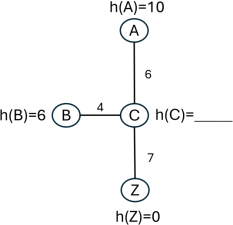
11) (8 points) Pick one or more: Among the values below, select all those that would result in h being admissible.
A) ○ 2
B) ○ 4
C) ○ 6
D) ○ 8
12) (8 points) Pick one or more: Among the values below, select all those that would result in h being consistent.
A) ○ 2
B) ○ 4
C) ○ 6
D) ○ 8
Section 6 (Problems 13 – 14)
In this section, consider path search algorithms in general, not necessarily applied to any specific graph given elsewhere in this exam. Also assume in this section the use of graph search, not tree-like search, for every algorithm (including Depth-First).
Suppose an agent is running a path search algorithm on a real-world (finite) map, to find a path from one city to another.
13) (9 points) Pick one or more: Select the path search algorithm(s) that is/are guaranteed to give the agent a cost-optimal path.
A) ○ Breadth-First
B) ○ Uniform Cost
C) ○ Depth-First
D) ○ Depth-Limited
E) ○ Iterative Deepening
F) ○ Greedy Best-First
G) ○ A* with an inadmissible heuristic
H) ○ A* with an admissible heuristic
I) ○ A* with a consistent heuristic
14) (9 points) Pick one or more: Consider the same scenario as the previous problem. Select the path search algorithm(s) that is/are guaranteed to find a path from one city to another if there is one.
A) ○ Breadth-First
B) ○ Uniform Cost
C) ○ Depth-First
D) ○ Depth-Limited
E) ○ Iterative Deepening
F) ○ Greedy Best-First
G) ○ A* with an inadmissible heuristic
H) ○ A* with an admissible heuristic
I) ○ A* with a consistent heuristic
Section 7 (Problems 15 – 20)
15) (3 points) Pick one: In a particular path search problem, suppose the only goal state is at a known depth, d. Consider Depth-Limited Search with a depth limit L. Which condition best describes what is required to find a path that contains the minimum number of
steps?
A) ○ d < L
B) ○ d ≤ L
C) ○ d = L
D) ○ d > L
E) ○ d ≥ L
16) (3 points) Assume all action costs are ≥ ∈ > 0. True or False: In Uniform Cost Search, the first time a node is expanded, that node has the smallest path cost to that state.
A) ○ True
B) ○ False
17) (3 points) Pick one: Consider a problem with a large state space that could be posed either as a systematic path search or as local search. Which of the following is a key advantage of local search algorithms over systematic search algorithms like A*?
A) ○ They are always complete.
B) ○ They always find the global optimum.
C) ○ They always terminate in polynomial time.
D) ○ They always use less memory.
18) (4 points) Pick one: Which of the following is FALSE about simulated annealing?
|
A) ○ |
For lower ΔE > 0, p is higher. |
|
B) ○ |
A large ΔE means the successor state is significantly worse than the current state. |
|
C) ○ |
A high p means we are more likely to accept only a move to a higher-valued state. |
|
D) ○ |
For higher T, p decreases more slowly with respect to ΔE. |
|
E) ○ |
A high T means we are more willing to accept a lower-valued successor state. |
19) (4 points) Pick one: Which of the following is FALSE about genetic algorithms as defined in class?
|
A) ○ |
Mutation allows for jumps into other parts of the solution space. |
|
B) ○ |
At each iteration, the size of the population stays the same. |
|
C) ○ |
Each individual must have internal structure. |
|
D) ○ |
The least fit pair of individuals could be selected for crossover. |
|
E) ○ |
Crossover combines the highest-rated genes of each parent. |
20) (12 points) Pick one or more: Consider minimax with alpha-beta pruning. Suppose that when an arbitrary decision is needed about the order in which nodes are considered, we choose the node earlier in the alphabet first. Observe the search tree below:

Among the nodes listed, choose all that can be pruned:
○ J ○ K ○ M ○ P ○ Q ○ R
Section 8 (Problems 21 – 22)
In this section, consider the CSP: A with DA = {2, 3, 5}
B with DB = <domain not shown here> Constraint: B % A = 0
where % is the modulus (remainder) operator.
21) (12 points) Pick one or more: Among the possible values of DB listed below, choose all that would make B arc-consistent with respect to A.
A) ○ {6}
B) ○ {30}
C) ○ {8, 9, 25}
D) ○ {16, 21, 22, 35}
22) (12 points) Pick one or more: Among the possible values of DB listed below, choose all that would make A arc-consistent with respect to B.
A) ○ {6}
B) ○ {30}
C) ○ {8, 9, 25}
D) ○ {16, 21, 22, 35}
Section 9 (Problems 23 – 24)
23) (3 points) Pick one or more: Let α and β be propositional logic sentences. Suppose α ⊨ β . Select the statement(s) below that must be true.
A) ○ α → β is satisfiable
B) ○ ¬(α → β ) is satisfiable
C) ○ α Λ ¬β is satisfiable
D) ○ None of the above must be true
24) (3 points) Pick one or more: Let KB be a propositional logic knowledge base and α a propositional logic sentence. Suppose that KB ⊨ α . Select the statement(s) below that must be true.
A) ○ α is true in all models
B) ○ M(KB) = M( α)
C) ○ KB satisfies α
D) ○ None of the above must be true
2025-10-20