Economics 5860: Health Economics
Hello, dear friend, you can consult us at any time if you have any questions, add WeChat: daixieit
Economics 5860: Health Economics
Practice Questions
A. True/False Explain. [5 points each]
Indicate whether each of the following statements is true or false and then explain why you think this. Include in your explanation any pertinent institutional details and economic reasoning (including appropriate graphs and equations). Points will be awarded for correct, concise, clear answers with minimal irrelevant detail. Explanation is required to receive points. Your answer should fit in the space provided.
1. The RAND Health Insurance Experiment was the first study to definitively show how more generous and comprehensive health insurance can lead to lower healthcare utilization.
2. According to the model of rational addiction, an increase in taxes on addictive goods allows consumers to try more of the addictive good without becoming an addict.
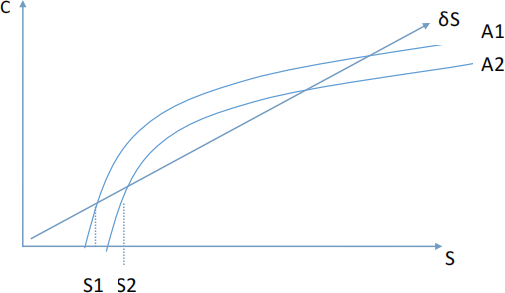
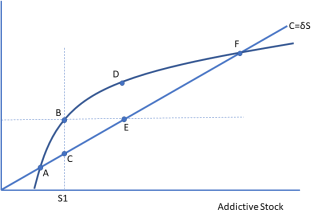
3. According to the model of rational addiction, a consumer with addictive capital S1 in time period 1 (in the graph below) will have addictive capital S1 plus the distance between points ‘B’ and ‘C’ in time period 2.
4. In the distant future, Spock will invent a medical tricorder device that heals all injuries and illnesses at zero marginal cost. After this invention, the deadweight loss from moral hazard caused by health insurance will decrease to zero.
Multiple Choice
5. Providing low-income adults with Medicaid resulted in all the following EXCEPT
a. more acute injuries, such as broken bones and traffic accidents
b. higher health care utilization
c. higher self-reported physical and mental health
d. increase in diabetes diagnoses
6. Consider a typical hospital CEO looking at the different types of patients they have: privately insured patients; those covered by Medicare; those covered by Medicaid; and those who are uninsured. What is the ordering of those patients in terms of profitability to the hospital?
a. Medicaid patients are more profitable, then privately insured, then Medicare, then the
b. Privately insured patients are more profitable, then Medicaid, then Medicare, then the uninsured.
c. Medicare patients are more profitable, then privately insured, then Medicaid, then the uninsured.
d. Privately insured patients are more profitable, then Medicare, then Medicaid, then the uninsured.
e. Medicare patients are more profitable, then privately insured, then the uninsured, then Medicaid.
7. A small island has three insurers and two non-profit hospitals. The insurers each reimburse the hospitals $1,000 for each hospital visit consumed by their customers. Suppose that the two hospitals merge, and bargain as one. What price might you expect the insurers to eventually pay for each hospitalization?
a. Less than $1,000
b. Exactly $1,000
c. More than $1,000
8. Suppose that a particular medical specialty switches from three-year residencies to four-year residencies. In the long run, what would happen to average salaries of physicians in that specialty?
a. They would increase
b. They would decrease
c. They would not change
Short Answer
9. [5 points] Dranove and Wehner (1994) argue that the statistical evidence used to support the supplier-induced demand hypothesis is invalid because they find that the same statistical techniques also suggest that obstetricians induce demand. In other words, having more obstetricians in an area is correlated with more births in that area. Briefly explain the supplier-induced demand hypothesis and why this finding by Dranove and Wehner does not support this hypothesis. [Note: This is not directly related to the lecture slides on Johnson and Rehavi (2014), which consider the delivery method for births, not the number of births.]
Analytical Problems
For all analytical problems, show your work for (potential) partial credit.
10. Suppose that demand for COVID vaccines is a function of price with D=300,000,000-100,000*P. Assume supply is perfectly elastic and the market price is $1600. This vaccine requires only one unit or dose per person. [15 points]
a) Assume nobody has insurance and everyone pays market price for the vaccine. How many units will be demanded?
b) Now assume the vaccine is free, how many units will be demanded? If the population of the united states is 350 million, what share of the population will get a vaccine?
c) Now assume the vaccine price drops from market price to just a 10% copay (assume 90% of the price is paid by the government). Draw a graph showing the gain in consumer surplus. [2pts, 1 for correct shape/intuition, 1 for correct answer] New Demand: D=300,000,000 – 100,000 x 160 = 284,000,000
d) What is the increase in spending by the government? [2pts, 1 for correct shape/intuition, 1 for correct answer]
e) What is the total deadweight loss? [2pts, 1 for correct shape/intuition, 1 for correct answer]
f) This welfare calculation only included individual consumer and producer surplus due to prices individuals paid or received for the vaccine. Name three other factors a welfare calculation of vaccines may involve besides prices.
11. Physician Supply: The supply of physician office visits is given by QS=40P-1000, and demand for physician office visits is QD=6000-60P.
a. [2 points] If the market is perfectly competitive, what are the equilibrium price and quantity?
b. [3 points] Suppose there is an entry barrier that prevents new physicians from entering the market, which limits QS= 1200. What is the market price given this entry barrier?
c. [3 points] How much total welfare (consumer surplus + producer surplus) is lost because of the entry barrier?
12. Explain the basic tradeoff a state makes when it tightens regulations on licenses for physicians, dentists or other professionals. What are the costs and benefits? [There are a few possible answers: any three correct ones will get full credit.] [6pts]
13. Mergers in England [12 pts]
a. A small town in England has three hospitals. The largest hospital controls half of the market, the second-largest controls 40% of the market, and the final hospital controls the remainder. What is the Herfindal-Hirschman index for this hospital market?
b. Next year, the herfindal index of competition in this town is 5,000. Does this represent an increase or decrease in competition? [3pt]
c. Why might hospital mergers be bad for consumers? [3 pts]
d. Why might hospital mergers lead to improvements in the quality of care for a given level of inputs? [3pts]
2025-09-26