MCB 104 - Fall 2024 - Midterm 1 - September 25, 2024
Hello, dear friend, you can consult us at any time if you have any questions, add WeChat: daixieit
MCB 104 - Fall 2024 - Midterm 1 - September 25, 2024
You may use a calculator.
You can report numbers as fractions or decimals, and can round decimals to 3 significant digits.
Some reminders:
There are 3.1 billion bases in one copy of the human genome.
Humans have 22 pairs of autosomes (numbered 1 to 22) and one pair of sex chromosomes (X andY).
There are on average 1 crossover plus 1 per 50 million basepairs for a chromosome in females, and 1 crossover plus 1 per 100 million basepairs for a chromosome in males.
In humans 1Mb (1,000,000 basepairs of DNA) = 1cM (an average of 1 recombination per 100 meioses).
There is no recombination on the X chromosome in males.
 In pedigrees have sex chromosome genotype XY
 In pedigrees have sex chromosome genotype XX
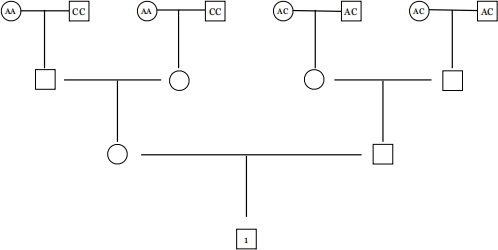
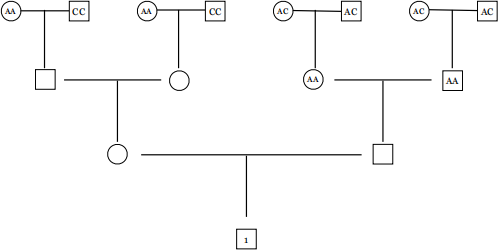
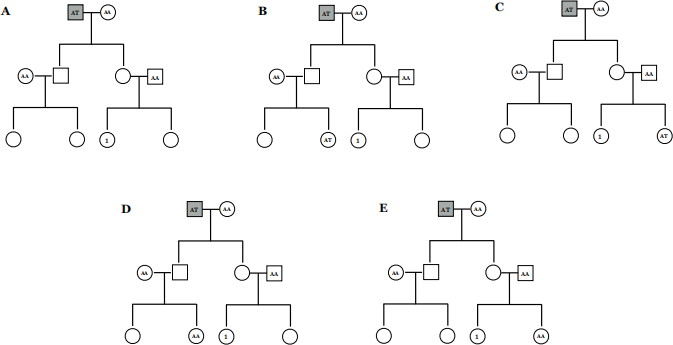
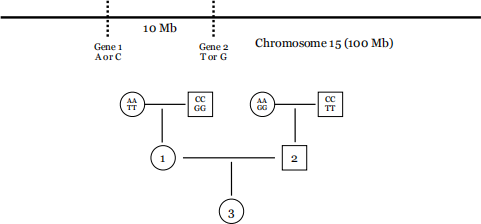
 Text in pedigree box represents the genotype of the individual for the loci in the question. If no genotype is given, the genotype is unknown.
Question 1 (20 points)
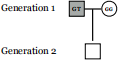
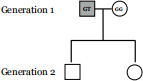
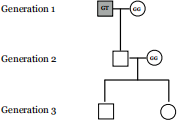
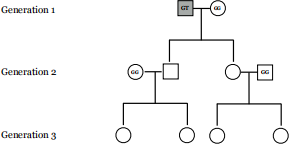
In all of the questions below, the shaded individual in the pedigree below inherits a new mutation from G to T at a site on chromosome 1 (which is not a sex chromosome).
a) (5 points) If the person with the new T allele in generation 1 has one child, as shown below, what is the probability that the T allele is still present in generation 2?
b) (5 points) If the person with the new T allele in generation 1 has two children, as shown below, what is the probability that the T allele is still present in generation 2 (meaning at least one of the two children has it)?
c) (5 points) If the person with the new T allele in generation 1 has one child, and they have two children, as shown below, what is the probability that the T allele is still present in generation 3 (meaning at least one of the original person,s two grandchildren has it)?
d) (5 points) If the person with the new T allele in generation 1 has two child, and they each have two children, as shown below, what is the probability that the T allele is still present in generation 3 (meaning at least one of the original person,s four grandchildren has it)?
Question 2 (10 points)
(10 points) What is the probability that individual 1 has the genotype AA?
Question 3 (5 points)
(5 points) What is the probability that individual 1 has the genotype AA?
Question 4 (10 points)
Rank the five pedigrees shown below in order of the probability (1) will have the genotype AT. The answer should be written like this: C < D < A < B if you think C is the least likely, then D, then A then B).
If you think two are equal, you can indicate it like this: C < D = A < B PLEASE EXPLAIN YOUR ANSWER.
Question 5 (20 points)
Gene 1 on human chromosome 15 (which is approximately 100,000,000 bases, or 100 Mb, long) has a single nucleotide polymorphism at base 30,000,000 where some genomes have an A and some a C. Gene 2 on the same chromosome has a single nucleotide polymorphism at base 40,000,000 from where some genomes have a G and some a T.
Given the pedigree below, where an individual,s genotype at Gene 1 is shown on top and their genotype at Gene 2 below, what is the probability that individual 3 has the genotype AA at Gene 1 and GG at Gene 2? (Use the crossover method to calculate recombination frequencies. You may optionally use the map distance method only to check your work. )
Question 6 (16 points)
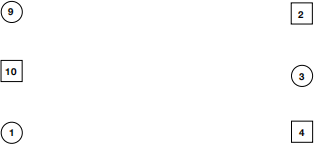
Consider two sites on the X chromosome Site 1 has alleles A and C. Site 2 has alleles G and T. Given the pedigree shown below, answer the following questions. (Note that this is similar to, but not exactly the same, as the tree in HW 3).
a) (5 points) Given all the information in the tree, what does the fact that 15 is CG tell you about the X chromosome of 14?
b) (5 points) Given all the information in the tree, what does the fact that 15 is CG tell you about the X chromosome of 13? Please indicate which alleles are found on the same chromosome.
c) (6 points) What are the genotypes ofthe following individuals:
Question 7 (8 points)
Both of individual 1,s parents are heterozygous at two sites on chromosome 15 (100 Mb), and each has one chromosome with an A at site 1 and a C at site 2, and another chromosome with a T at site 1 and a G at site 2.
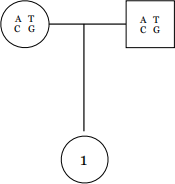
a) (4 points) From which parent (mother or father) is individual 1 most likely to receive a chromosome with A at site 1 and G at site 2?
b) (4 points) From which parent (mother or father) is individual 1 most likely to receive a chromosome with A at site 1 and A at site 2? (No, this is not a typo).
Question 8 (6 points)
a) (4 points) Tortoiseshell cats have one X chromosome carrying a brown pigmentation gene and one with an orange pigmentation gene. Why do they end up with patches of orange and brown fur?
a) (2 points) Most, but not all, calico cats are female. How is it possible to have a male calico cat?
Question 9 (5 points)
Ten generations ago four T to A mutations occurred in the same individual. Sites 1 and 2 are 10,000,000 basepairs apart on chromosome 7, which is 150 Mb long. Sites 3 and 4 are 10,000,000 basepairs apart on the X chromosome, which is also 150 Mb long. If one of this person,s living descendants has an A at sites 1 and 3, how do the odds of their having an A at site 2 compare to their odds of having an A at site 4, and why? Assume that anyone who is not a descendant of person in whom the A mutations arose has all T,s.
2025-09-25