BIOL 101: Guided Reading Questions L2
Hello, dear friend, you can consult us at any time if you have any questions, add WeChat: daixieit
BIOL 101: Guided Reading Questions (GRQs)
Complete and submit this GRQ as a PDF before lecture and before your online Mastering Assignment
L2 GRQs: Structure/Function of Macromolecules
Reading objectives (use these statements to study in a more open-ended way.)
• Explain and give examples of the major themes in biology such as: evolution, flow of information, structure and function, transformation of matter and energy, interactions within and between
systems
• Describe differences in molecular bonds that hold organic molecules together.
• Explain the structure and function (and categorize) the monomers and polymers of carbohydrates, lipids, proteins, and nucleic acids.
• Compare observational vs. experimental studies and retrospective vs. prospective studies • Explain the evolution of lactose tolerance
Modules 1.9 - 1.14: Themes of biology
1. There are five unifying themes in biology that we will discuss throughout the semester. Expect overlap—one topic we are learning about may provide examples of many themes.
List the five themes and a brief description of each before we go through each in more depth:
1.Evolution is the core theme of biology: Darwin synthesized the theory of evolution by natural selection .
2.Life depends on interactions within and between systems: Properties are the results of interactions and between in the system.
3.Life depends on the flow of information: DNA is the primary information that passed down from the generations. Informations that comes both external and internal stimuli, organism will react to this stimulus and informations.
4.Structure and function are related:structure is related to all levels of organisms.
5.Life depends on the transfer and transformation of energy and matter: Chemical and other energy will flows through an ecosystem in single directions. Ecosystem work as a circle that composed by various part.
FOUNDATIONAL KNOWLEDGE FUN! Check out this short (3 min) video to review chemical bonds—this is important when thinking about molecules in your body!
Take notes if it helps you! https://www.youtube.com/watch?v=ts-FuUp7b3c
Module 3.1: Life’s molecular diversity is based on the properties of carbon
1. What is an organic compound?
organic compound is a compound containing carbon, usually bonded to hydrogen
2. Based on your definition, which one of these is an organic compound? Water, Carbon dioxide, Glucose
Module 3.2: A few chemical groups are key to the functioning of biological molecules
1. What does the word hydrophilic mean?
Hydrophilic means compounds containing polar that will interact easily with water.
2. What chemical groups can be found contained in the building blocks of proteins? Amino group and carboxyl group
Module 3.3: Cells make large molecules from a limited set of small molecules
1. Think about making a necklace with small beads. Use the necklace as an analogy to use the words macromolecule, monomer, polymer, dehydration reaction, and hydrolysis in sentences. Can you draw an example?
A necklace (polymer) is made of monomers. And dehydration and hydrolysis is different process that happens with in the reactions.
Module 3.4: Monosaccharides are the simplest carbohydrates
1. The monomers of carbohydrates are called: ___monosaccharides__________________. Name a few from the reading: glucose, fructose, galactose
2. The use of sugars as both energy resources and organic building blocks clearly illustrates one of our five themes of life, which one: ________Energy and Matter_______________?
Module 3.5: Two monosaccharides are linked to form a disaccharide
1. Describe how two monosaccharides are joined and what forms when they are chemically joined. They are joined by a dehydration reaction, forming a disaccharide.
Module 3.6: Are we eating too much sugar?
1. How much sugar does the typical American consume daily? ____ Yearly? ____
2. What correlation has the National Health and Nutrition Examination Survey (NHANES) study made with increased sugar consumption?
They found that higher sugar consumption correlates with greater risk of obesity, diabetes, and heart disease.
Module 3.7: Polysaccharides are long chains of sugar units
1. Three of the polysaccharides listed below are made of glucose as a repeating monomer, but it is assembled in different ways. What are these three glucose-based polysaccharides and what is each of their origin and function?
|
Glucose-based polysaccharide name |
Found in Plant or Animal? |
Function: Energy storage or Structural |
|
Starch |
Plant |
Energy |
|
Glycogen |
Animal |
Energy storage |
|
Cellulose. |
Plant |
Structural |
2. To break these down, would this be hydrolysis or a dehydration reaction? Can you draw it to refresh your memory?
It would be hydrolysis.
Module 3.8: Fats are lipids that are mostly energy-storage molecules
1. Most carbohydrates and other biological molecules are hydrophilic. What chemical property describes fats and how they interact with water?
Fats are hydrophobic
2. What, if any, are the monomers of fats? It’s glycerol + fatty acids
3. Compare and contrast unsaturated and saturated fats in terms of where they can be found (plant or animal).
Saturated fats always solid at room temperature, but the unsaturated fats will keep liquid in room temperature.
4. What is the main function of fats?
Storage energy.
Module 3.10: Phospholipids and steroids are important lipids with a variety of functions
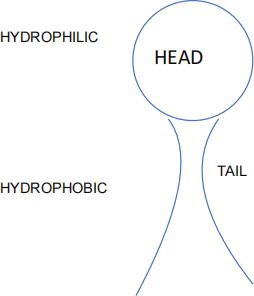
1. Draw and label a picture of a phospholipid (cartoon form, not the chemical structures)—Be sure to use these labels: head, tail, hydrophobic, hydrophillic
Module 3.12: Proteins have a wide range of functions and structures
1. What are the monomers of proteins? Is Amino acids
Complete and submit this GRQ as a PDF before lecture and before your online Mastering Assignment
2. A proteins’ function depends on it’s _____shape_____________. When a protein “unravels”
or unfolds we call this __denaturation __________________.
Module 3.13: Proteins are made from amino acids linked by peptide bonds
17. There are 20 different amino acids, what part of each amino acid makes it different from the other amino acids?
The R group makes it different for different amino acids.
Module 3.14: A Protein’s functional shape results from four levels of structure
FOUNDATIONAL KNOWLEDGE FUN: Check out the first 1.5 minutes of this video to review protein structure. Animations are also available in Mastering.
Take notes if it helps you! https://www.youtube.com/watch?v=1peFJ_-N7V8
1. Primary structure: Amino acid ___sequence______ join together through a dehydration reaction. The covalent bonds between amino acids are known as _peptide _______ bonds.
2.Secondary structure: ___hydrogen_________ bonds between the amino group of one amino acid and the carboxyl group of another amino acid. Two types of secondary structure occur:
_____α helix__________ and ______β pleated sheet__________.
3. The three-dimensional structure of a protein is called the ___Tertiary __________ structure.
*When we talk about structure and function of proteins, we are often focused on this level, this 3D structure.
4. Why do only some proteins have quaternary structure? because they are made of more than one polypeptide chain
Module 3.15: The nucleic acids DNA and RNA are information-rich polymers of nucleotides
1. What are the monomers of DNA called? Does RNA have different monomers? Is called Nucleotides. Yeah, RHA has different sugars and bases
2. The DNA sugar-phosphate backbone is held together by covalent bonds. What kinds of bonds hold the two strands of the double helix together?
They are held together by hydrogen bonds between complementary bases
Module 3.16: Lactose tolerance is a recent event in human evolution
1. Lactose tolerance is a mutation that has arisen many times in human evolution.
In which populations has this been naturally selected for as a useful adaptation?
Northern Europeans and middle Eastern.
2. Many people are lactose intolerant and take a few pills before eating dairy foods. What protein are these folks not able to produce? What is in those pills?
They lack of lactase, and the pills are lactase enzymes.
3. Are your ancestors from a region where you would expect lactose tolerance or intolerance?
Might you be lactose intolerant?
Nope, I m from Asia, so I don’t have lactose intolerance.
2025-09-24