BIOL 101: Guided Reading Questions L1
Hello, dear friend, you can consult us at any time if you have any questions, add WeChat: daixieit
BIOL 101: Guided Reading Questions (GRQs)
Complete and submit this GRQ as a PDF before lecture and before your online Mastering Assignment
L1 GRQs: Exploring Life and the Process of Science
(The highlighted modules from the chapter can be used to answer the questions; you are not responsible for material that is not part of the answer to a question below)
Reading objectives (use these statements later to study in a more open-ended way)
· Define the properties of life
· Describe the components of hypothesis-driven science, including controlled and observational studies.
Module 1.1: Biology is the scientific study of life
1. What are the characteristics that define all life? (Hint: check the figure)
2. What is the smallest unit of life?
3. THINK and EXPLORE: Most biologists do not think viruses are “alive” because they reproduce on their own. But within a host, like you, they can replicate and evolve…so they are a grey area. If you are interested in this, do some google searches on “are viruses alive?” and see some of the debate.
Module 1.3: In life’s hierarchy of organization, new properties emerge at each level
1. Arrange these words in a correct order: community, cell, organism, organ system, biosphere, molecule, tissue, organelle, population, organ, ecosystem
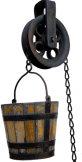
2. Consider the individual properties and uses for a bucket, a chain, or a wheel. What happens when you put them together in a system, how does a larger function emerge?
3. Similarly, individual tissues can have specific functions, but when put together with other tissue types in certain configurations in organs, new functions arise. This concept is known in biology as ____________ (2 words).
Module 1.4: What is science?
1. Review and define the terms below:
A. Quantitative Data are generally _____________ measurements.
B. Qualitative Data are generally in the form of _____________________.
C. A hypothesis is a proposed ____________ for a set of _____________.
D. A hypothesis leads to a ___________ that we can test.
E. An experiment is a ____________ carried out under ____________ conditions.
2. How do we prove a hypothesis is true?
3. How is a theory different from a hypothesis?
4. How is science different from other ways of describing and explaining nature, such as philosophy and religion? Fill in the rest of this statement from the text: The scientific view of the world is based on ______________ .
5. What is the main requirement for a scientific hypothesis?
(Note, this is the end of module question from 1.4—these are also very useful review quiz-like questions during reading and studying).
Module 1.5: Hypotheses can be tested using controlled experiments
1. Review and define the terms below based on the described experiment:
A. The hypothesis being tested with the two groups of mice is: ___________.
B. Independent variables are ____________ by the researcher.
C. The dependent variable is ____________ to judge the outcome of the experiment.
D. Control groups differ in only ______________ compared to the experimental group.
2. As you learned in Module 1.4, predictions are “if….then…” statements.
What was the “if…. then” prediction statement made by the scientists about the beach mouse?
Noting the independent and the dependent variables, describe the control and experimental groups.
Describe the results and conclusion.
(Note: orange “TRY THIS” box on the page. It is an active thinking question. These make great quiz-like review practice questions in your reading and studying).
Module 1. 6: Hypotheses can be tested using observational studies
1. Module 1.6 details how hypotheses can be tested even if a controlled experiment cannot be performed. Explain how observational data led to classification of the red panda:
Module 1.7: The process of science is repetitive , nonlinear, and collaborative
13. The flashlight figure might give you the impression that there is a linear, recipe to follow for science. In fact, most scientific studies are non-linear and require repetition and collaboration. Draw Figure 1.7 below (and explain the components to yourself), as we will be referring to this figure throughout the semester. (Note: Biology requires a fair amount of drawing, so use these GRQs as a place to practice this skill).
Congratulations, you finished the first GRQ!
What now? Complete the Mastering Biology activities and questions. Remember these are due before class, but you can turn in a limited amount of oops tokens (see course Web site for information) if you don’t complete things in time. Also, the end of chapter questions in the textbook are available to you now or when you are studying in the future. These make excellent review questions, including the “Connecting the Concepts, “Testing Your Knowledge” and, “Applying the Concepts” part. Check your independent answers in the appendix. Don’t forget to attend peer instructor session to ask questions for clarification!
2025-09-24