PHYC10003 PHYSICS 1
Hello, dear friend, you can consult us at any time if you have any questions, add WeChat: daixieit
PHYC10003
SESSION 1
THURSDAY 20 JUNE 2019
EXAMINATION QUESTION PAPER
SUBJECT NAME: PHYSICS 1
SUBJECT CODE: PHYC10003
EXAM DURATION: 3 hours NOT including reading time.
READING TIME: 15 MINS
TOTAL MARKS: This examination is worth 60 per cent of your total marks for this subject.
Question 1 16 marks
(a) A particle is travelling along a flat frictionless surface with a velocity described by the
equation 2l(^) + 3t2J(^) . Initially at t = 0, it has a position of (0)0).
(i) Calculate the speed of the particle at time t = 3.0 s.
(ii) Calculate, using (l(^)) J(^)) notation, the acceleration of the particle at t = 3.0 s.
(iii) Calculate, using (l(^)) J(^)) notation, the position of the particle at time t = 3.0 s.
(b) In the movie Skyscraper, Dwayne “The Rock” Johnson, jumps from a crane into a burning skyscraper to save his family.
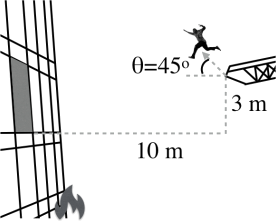
(i) Let’s first consider a practice jump on land. Calculate the “take-off” speed, v0 , of The Rock if he jumps at 45o degrees above the horizontal and lands 8.0 m away. Ignore the effects of air resistance.
(ii) In the movie, The Rock jumps a gap of 10.0 m between the crane and the open window of a skyscraper, which is 3.0 m vertically below. If he jumps at 45o with the speed calculated in (i), how far long, or short, of the skyscraper window will he be at the level of the window? Ignore the effects of air resistance.
(iii) If there is wind opposing the motion of The Rock that provides a horizontal acceleration of -1.0 m/s2 , what initial speed would he need to reach the window?
Question 2 15 marks
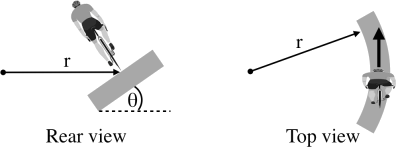
(a) A lecturer-cyclist does a left turn at constant speed without slipping on a horizontal road by following a circular path of radius 25 m.
(i) Draw a clearly labelled free-body diagram showing all forces acting on the
bicycle as it follows the circular path. Draw the diagram using the rear view of the bicycle.
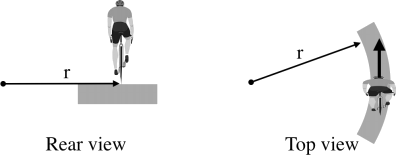
(ii) If the coefficient of static friction is μs = 0.7, how fast can the bicycle travel without slipping? Give your answer in units of km/hour.
(iii) To allow for high speed turns special cycling paths or velodromes are designed to have a sloped surface. Determine the angle of the slope, θ, that will allow bicycles to go around corners at a speed of 50 km/hour without slipping, even if the surface is wet. Assume the path has the same radius above.
(b) A 3.0 kg object has the following two forces acting on it:
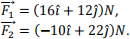
If the object is initially at rest, determine its velocity v(→) at t = 3.0 S.
[(3 + 3 + 4) + 5 = 15 marks]
Question 3 14 marks
(a) The figure shows the potential energy diagram for a 50 g particle that is released from rest at x = 0.5 m.
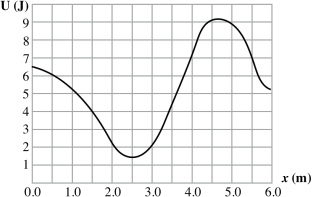
(i) Will the particle move in the positive or negative x-direction? Explain your answer.
(ii) What is the maximum speed of the particle?
(iii) What is the speed of the particle at x = 3.5 m?
(iv) At what position or positions will it change direction?
(v) At what position or positions on its trajectory will the net force on the particle be zero?
(b) A dark matter particle of mass mD and velocity VD collides elastically with a helium nucleus mHe (at rest initially) whose mass is four times that of the dark matter particle. The helium nucleus is observed to move off at an angle θD(I) with velocity VID, and the dark matter particle at θIHe with velocity VH(I)e (As shown in the diagram).
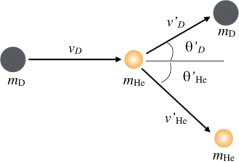
(i) By applying the relevant
conservation laws, write down 3 equations describing this collision in terms of variables mD, mHe, VD, VID, VIHe , θID, θIHe and explain what conditions are required.
(ii) In a particular situation, the dark matter particle’s initial speed is
2.2 × 10⁵ m/s, θID = 75.96o and θIHe = 45o. Determine the speeds of the two particles, VD(I) and VH(I)e after the collision.
[(2 + 2 + 2 + 1 + 1) + (3 + 3) = 14 marks]
Question 4 15 marks
Four small spheres, each of mass M kg, are placed at the vertices of a square of side-length L metres. They are fixed in this configuration by a rigid framework of negligible mass.
(a) What is the moment of inertia of this system with respect to rotation around an axis that is perpendicular to the plane of the square array and which passes through the centre of mass?
(b) What is the moment of inertia of this system with respect to rotation around an axis that passes through two of the masses that are diagonally opposite one another on the square plane?
(c) Use the parallel axis theorem and your answer to Part (a) to determine the
moment of inertia of the system with respect to rotation around an axis that is perpendicular to the plane of the square array and that passes through the midpoint of one of its edges.
(d) If the angular momentum for each of the rotational axes above is the same, which one of (a), (b) or (c) would have the
(i) greatest angular speed?
(ii) greatest kinetic energy?
[3 + 3 + 5 + (2 + 2) = 15 marks]
Question 5 15 marks
Ada is a brave volunteer who agrees to participate in a PHYC10003 lecture demonstration. She sits on a chair that is able to swivel freely; the bearings may be regarded as frictionless. She holds two weights in her hands with her arms outstretched horizontally. The chair is spun until it reaches an angular speed of 1.2 revolutions per second. Initially, the rotational inertia of the system consisting of the chair, Ada and the weights around the rotational axis is 6.0 kg.m2. Ada then moves her arms to reduce the moment of inertia of the system to 2.0 kg.m2.
(a) What is the new rotational speed of the system?
(b) What is the ratio of the rotational kinetic energies before and after Ada moves her arms?
(c) Where did the energy come from that has affected this change in rotational energy?
(d) If Ada transferred both of the weights to one hand and outstretched her
arms, would her rotational speed be greater than, less than or equal to 1.2 revolutions per second? Explain your answer.
[ 3 + 5 + 3 + 4 = 15 marks]
Question 6 20 marks
(a) At what speed must a clock move if it runs at a rate which is one-half the rate of a clock at rest?
(b) At what speed does a metre long stick move if its length as measured by a stationary observer is only 0.5 m?
(c) The average lifetime of a charged π meson (rest mass 139.57 MeV/c2 or 2.49x10⁻²⁸ kg) in its own frame of reference is 26.0 ns.
(i) Define proper time.
(ii) If the π meson moves with speed 0.95c with respect to the Earth, what is its lifetime as measured by an observer at rest on Earth?
(iii) What is the average distance it travels before decaying as measured by an observer at rest on Earth?
(d) A train, length d, is moving in the direction shown at velocity v, with respect to the tracks.
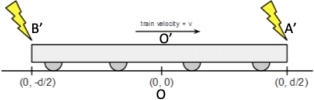
As the centre of the train passes stationary observer O, beside the train tracks, the observer sees two lightning bolts strike simultaneously at each end of the train, A’ and B’.
(i) What is the length of the train as seen by the stationary observer O?
(ii) Explain the relativity of simultaneity.
(iii) Show that the observer O’, sitting on the train at the midpoint between A’ and B’ will see the lightning strike at A’ before B’ .
(iv) What is the time difference between the lightning strikes as observed by O’ on the train?
[ 4 + 2 + (1 + 2 + 2) + (2 + 1 + 3 + 3) = 20 marks]
Question 7 9 marks
An astronaut finds herself on an unknown planet and needs to calculate the acceleration due to gravity on the planet. Using a piece of string 1.5 m long and a mass of 50 g as a pendulum, she counts 10 complete oscillations in 40 seconds.
(a) Show that the acceleration due to gravity on the surface of the planet is 3.7 ms-2
With various observations (and a bit of trigonometry) the astronaut estimates the radius of this unknown planet to be 5,000 km.
(b) Equating Newton’s second law with Newton’s law of gravitation show:

(c) Using energy balance show that the escape speed is given by:

(d) Hence calculate the escape speed the astronaut will need to achieve to leave the planet.
[4 + 2 + 2 + 1 = 9 marks]
Question 8 17 marks
(a) The displacement due to a transverse wave on a string, of mass per unit length 20g/m, is

Determine the following:
(i) the wave amplitude
(ii) the wavelength
(iii) the period
(iv) the speed of the wave
(v) the string tension
(b) If the above wave, D1, is added in superposition with D2 below:

(i) Find the displacement resulting from the superposition of these waves
(ii) Is the resulting wave a travelling wave? Explain your answer.
(iii) Find the value of the separation between adjacent maxima of the combined wave.
(c) A spring hangs from a ceiling, neither stretched nor compressed, with a spring constant of k = 90 N/m. A mass of 5.0 kg is attached to the lower end of the spring, released and allowed to oscillate up and down.
(i) Determine the period of oscillation of the spring-mass system.
(ii) Determine the amplitude of the oscillation.
[1 + 1 + 1 + 2 + 2) + (3 + 1 + 2) + (2 + 2) = 17 marks]
Question 9 19 marks
(a) Calculate the refractive index of a material in which the speed of light is 2.012 x 10⁸ ms-1
(b) A coin is placed at the bottom of a beaker under 15cm of water. The refractive index of water is 1.333 (~4/3). Calculate the apparent depth of the coin.
(Assume the small angle approximation tanθ ≈ sinθ)
(c) A light ray is emitted from a point 5m below the surface of a liquid with air above it. It undergoes total internal reflection if it meets the surface with an angle greater than the critical angle, θc , as shown in the figure.
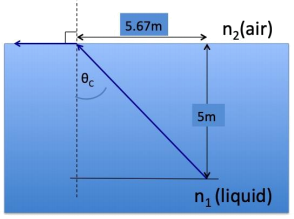
(i) Calculate the index of refraction of the liquid.
(ii) Describe the impact of refraction on the view of a diver looking upwards from 5m under water.
(d) What is the focal length of a 2.0 dioptre lens used in a pair of reading glasses?
(e) If the power of a typical human cornea (eye lens) is 40 dioptre, what is the combined focal length of the eye and the reading glasses in part (d) together?
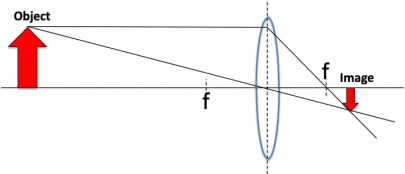
(f) The diagram shows the object and image typical of a camera.
(i) How far from the camera lens must the detector be, if the lens focal length is 50 mm, to focus on an object 75 cm away?
(ii) Is the image real or virtual?
(iii) What is the magnification of the image?
[ 1 + 4 + (3 + 2) + 1 + 2 + (3 + 2 + 1) = 19 marks]
Question 10 10 marks
(a) Calculate the wavelengths of sounds at the (typical) extremes of the human audible frequency range 20 - 20,000 Hz. (Use the speed of sound, vair = 343 m/s.)
(b) Show that if one sound is twice as intense as another, it has a sound level approximately 3 dB higher.
(c) Briefly explain the Doppler effect in the context of sound waves.
(d) If the frequency of a stationary emergency vehicle siren is 1 kHz, what is the difference in frequency between that heard when the vehicle is approaching an observer at 20 m/s and the frequency heard as the vehicle moves away at the same speed?
[ 2 + 2 + 2 + 4 = 10 marks]
2025-09-24