econ30022 Assignment #1
Hello, dear friend, you can consult us at any time if you have any questions, add WeChat: daixieit
Assignment #1
Due September 12th — Upload as a PDF to LMS by 11:59 PM
General Instructions:
● Please answer the questions below as succinctly as possible — Graphs and Figures do not count against your word count.
● You may work with other students on the problem set, but you must write up your solutions independently.
● You may not use LLMs to help solve the problem set. However, you may send your final solutions through LLMs for editing. If you do so, you must cite the model that was used for editing at the end of your problem set.
Overview:
Laboratory labor market experiments have found a consistent positive relationship between higher wages and higher effort. Many papers have argued that this positive relationship can lead to departures from the competitive equilibrium (Fehr, Riedl and Kirchsteiger, 1993; Falk et al. (2006); Engelmann and Kübler (2007); Owens and Kagel (2009); and Brandts and Charness (2004)). In this problem set, we are going to look at design decisions made in the earliest of these papers (Fehr, Riedl and Kirchsteiger, 1993) and determine how these decisions are likely to influence the payoff of inducing high effort.
Question 1:
Consider an environment with a single worker and a single firm. In a one-shot interaction, the two parties play the following game.
Stage 1 - The Offer Stage: In stage 1, the firm makes a take-it-or-leave-it wage offer to the worker. The worker may accept employment or reject employment. If the worker rejects employment he receives a payment of 5 from a secondary source and the game ends. If the worker accepts employment we move to stage 2.
Stage 2 - The Effort Stage: In stage 2 he/she chooses how much effort to exert. Effort is costly to the worker but increases the earnings ofthe firm. The workers effort e ∈ [1,10] is bounded above and below.
Stage 3 - Payoff Stage: In stage 3, the worker and the firm is paid. A selfish worker receives utility

A selfish firm receives a payoff of

The wage of the worker is determined prior to the payoff stage and thus cannot be used for incentives. As this is a single shot relationship, bonuses are also not credible.
1. Draw the extensive form game.
2. What is the minimum wage that a firm can offer and have the worker accept?
3. Determine the SPNE of the game.
Question 2:
Suppose that some of the workers have positive reciprocity and have a preference for rewarding higher wages with more effort. Specifically, following Charness (2004), assume that the utility of workers is given by:
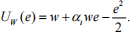
where αi is the level of positive reciprocity of the individual.
1. What is the minimum wage that a firm can offer and have the worker accept the contract and put in an effort of 1? (This will be similar to part 2 of question 1 found above except that we need to include αi )
2. As a function of w and αi , determine the value of e(w, αi ) 1. Keep in mind that effort is bounded between 1 and 10.
3. Draw the relationship between wages and effort.
In a principal agent framework, we typically can solve for the principal's program by solving for the agent's optimal effort and plugging it into the profit equation. Doing so in this problem would lead to the principal maximizing:

Subject to the constraints that e is bounded between 1 and 10. To keep things simple, lets assume that αi is known so that E(αi ) = α . The principal’s problem can then be written as:
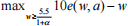
Subject to the constraints that e is bounded between 1 and 10.
4. Ignoring the boundary constraints, for what value of α are profits increasing in w?
(i.e., take the derivative of the principal’s maximization problem and determine under what conditions the derivative is positive.)
Your solution in part (4) should indicate that the firm will prefer to either to induce full effort or minimal effort. This implies that we can just look at the boundary conditions to determine when a profit maximizing firm will set wages above the competitive equilibrium.
5. Determine the lowest wage necessary to generate an effort of 10.
6. Calculate the profits ofthe firm for inducing an effort of 10.
7. Calculate the profits ofthe firm for inducing an effort of 1. Note that our wage choice must satisfy the workers individual rationality constraint found in part (1).
8. Using these two calculations, determine the level of α required for the high wage/high effort equilibrium to be profitable for the firm. (This number won’t come out to be nice).
Question 3:
In Fehr, Riedl and Kirchsteiger (1993) the authors are concerned with the potential that the firms could take heavy losses in the experiment. To avoid issues of negative payoffs, FRK use the following profit function for the firm:
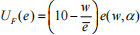
Where  is the upper bound of the effort distribution. In our case
  =10.
=10.
1. Ignoring the boundary conditions, find the wage that maximizes profits. (i.e., take the first order condition and set it equal to zero. Your answer here should identify an optimal wage. The rest ofthe problem compares the profits using this wage against the profits that could be created by inducing an effort of 1.)
2. Calculate the profits ofthe firm for selecting the wage found in part (1).
3. Calculate the profits ofthe firm for inducing an effort of 1.
4. What is the minimal α for which the firm makes more profit choosing the wage found in part (1) instead of choosing the wage in part (3)?
5. FRK argue that their profit function is designed only to eliminate negative earnings. Explain why the choice of profit functions may have unintended consequences here.
6. We could rewrite the profit function used in FRK as:
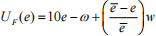
Is there a type of product that one might purchase that is similar to the last term? How do we think this type of product would affect the willingness of participants to engage in gift exchange?
Question 4:
Noting the potential issues discussed above, an honours student ran a variant of the FHK experiment where he uses the original profit function rather than the FHK profit function. Data from his experiment from the first three periods is given in figures 1 and 2 on the next page.
1. Explain what the regression line represents in Figure 1. Why are we using a
Tobit regression rather than a standard linear regression? (Note: I am not looking for a technical discussion here, just discuss what the Tobit regression is trying to fix.)
2. In his experiment, all the groups converged to the Competitive Equilibrium. Would we expect the same result if the utility function from FRK was used?
3. One very apparent characteristic of his data is the heterogeneity of effort across worker types for intermediate wages. For what effort levels would it be profitable to offer a wage of 30? Based on this observation and Figure 2, explain why heterogeneity may be an important feature in labour markets.
4. Positive Reciprocity is often referred to as an "Auxiliary" force which helps to jump start reputation systems. Explain why heterogeneity in positive reciprocity levels might lead to globally high levels of high wages and high effort if individuals can be fired.
Figure 1:
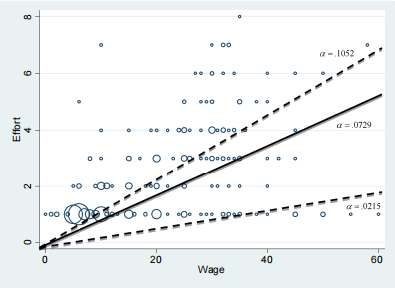
Figure 1: The Wage-Effort Relationship (Simple Linear Regression)
Tobit Regression (censored at 1, no intercept): α = .0729
Figure 2:
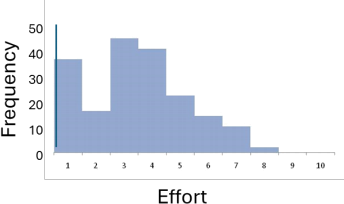
Figure 2: Histogram of Effort levels for workers who receive wages between 25 and 40
2025-09-19