CW#1
Hello, dear friend, you can consult us at any time if you have any questions, add WeChat: daixieit
CW#1 (due April 23rd @17:00, 2024)
Instructions:
i. This assignment consists of 50% of the CW marks of BIO312;
ii. You can refer to any materials, but please complete the coursework by yourself.
iii. Please submit your work in Word or PDF format;
iv. Marking: 50 marks for answering Q1-Q3.
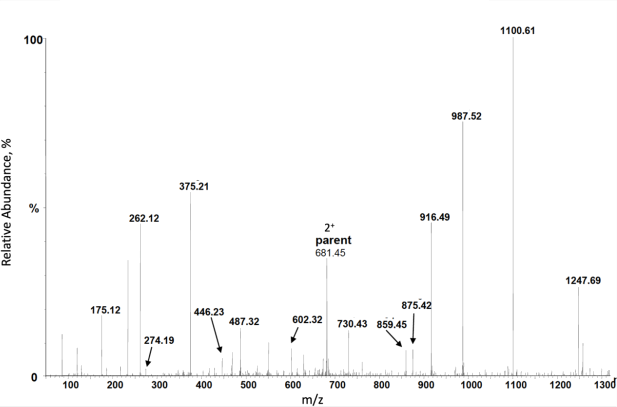
1. [15 marks] Determine the full sequence of the 12-residue peptide. Can you assign the sequence with this data alone? If not, briefly explain why. Please list the key steps of the de novo sequencing.
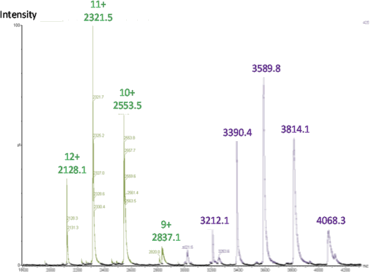
2. [10 marks] Figure below shows a mass spectrum of protein A (green) and a noncovalent protein complex AB (purple).
(i) Which ionization source has been used? Briefly describe it.
(ii) Calculate the molecular weight of the protein and the protein complex from the mass spectrum.
3. [25 marks] An investigator found two single nucleotide polymorphisms (SNPs) on a protein but not sure whether the corresponding mutated protein(s) is also expressed. He decided to isolate this protein using an immunoprecipitation approach and hope to pull down both the WT and the mutant(s) (if it’s expressed at all) together. To confirm the mutant(s) was indeed expressed, he then submitted the sample to a proteomics core lab looking for help.
If you are a scientist working in the core lab and asked to take on this project, how would you proceed? Please propose necessary experimental steps to find out whether the mutant(s) was expressed.
Here is the amino acid sequence information for the WT protein and the two potential mutation sites (red, underlined and bold).
MILVDLEPGTMDSVRSGPFGQIFRPDNFVFGQSGAGNNWAKGHYTEGAELVDSVLDVVRKEAESCDCLQGFQLTHSLGGGTGSGMGTLLISKIREEYPDRIMNTFSVVPSPKVSDTVVEPYNATLSVHQLVENTDETYCIDNEALYDICFRTLRLTTPTYGDLNHLVSGTMECVTTCLRFPGQLNADLRKLAVNMVPFPRLHFFMPGFAPLTSRGSQQYRALTVPDLTQQVFDAKNMMAACDPRHGRYLTVAAVFRGRMSMKEVDEQMLNVQNKNSSYFVEWIPNNVKTAVCDIPPRGLKMAVTFIGNSTAIQELFKRISEQFTAMFRRKAFLHWYTGEGMDEMEFTEAESNMNDLVSEYQQYQDATAEEEEDFGEEAEEEA
(potential mutations suggested by the SNP analysis: “D” to “N” and “K” to “Q”)
2025-08-14