TT3 Practice Problems
Hello, dear friend, you can consult us at any time if you have any questions, add WeChat: daixieit
TT3 Practice Problems
1. Sample Multiple Choice/Short Answer Questions:
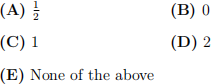
(1) Find the volume of the solid which lies below the plane z = x and above the rectangle {(x, y)} | 0 ≤ x ≤ 1, 1 ≤ y ≤ 3}
(2) The integral
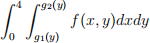
is the volume of the solid enclosed by the surfaces z = x2 , y = x2 , and the planes z = 0, y = 4. Find f(x, y) = , g1(y) = , and g2(y) = .
(3) Evaluate  dxdy
dxdy

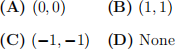
(4) A function f has three critical points (0, 0),(1, 1) and (−1, −1) and its partial derivatives are fx = 4x3 − 4y and fy = 4y3 − 4x. Which one of the critical points is a saddle point?
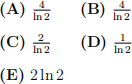
(5) Suppose 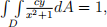 where D is the region bounded by the curve y =
√x, and the lines x = 1 and y = 0. Find the value of the constant c.
where D is the region bounded by the curve y =
√x, and the lines x = 1 and y = 0. Find the value of the constant c.
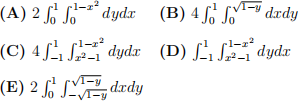
(6) Find the integral that gives the volume of the solid which is bounded by the plane z = 0, the plane z = 4, the cylinder x2 + y − 1 = 0, and the cylinder x2 − y − 1 = 0.
(7) Set up the volume of the solid bounded by the surface x = √1 − z, the planes x = 0, y = 0, y = 1 and z = 0 as an iterated integral in the order dydxdz
Answer:
(8) Evaluate the iterated integral by converting to polar coordinates. Round the answer to two decimal places.
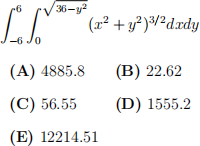
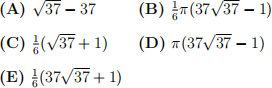
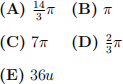
(9) Find the surface area of the part of the surface z = 9 − x2 − y2 that lies above the xy-plane.
(10) Express the integral as an iterated integral of the form

where E is the solid bounded by the surfaces x 2 = 1 − y, z = 3, and z = y.
Answer:
(11) Use cylindrical coordinates to evaluate  where T is the solid bounded by the cylinder x
2 + y
2 = 1 and the planes z = 3 and z = 4.
where T is the solid bounded by the cylinder x
2 + y
2 = 1 and the planes z = 3 and z = 4.
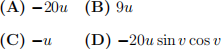
(12) Find the Jacobian of the transformation x = 5u sin v, y = 4u cos v,
2. Sample Long Answer Questions
(1) Let f(x, y) = x2 + y2 + x2y + 1.
(a) Find and classify all critical points of f in R2.
(b) Find the absolute maximum and minimum values of f on the square region with vertices (1, −1),(−1, 1),(1, 1) and (−1, −1).
(2) Find the volume of the solid bounded by the cylinder x2 + y2 = 4 and the planes z = 0, x + z = 4.
(3) Consider the iterated integral
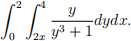
(a) Sketch the region of integration. Be sure to label your axes and to identify any points of interest (e.g. intercepts of points of intersection).
(b) Evaluate the integral.
(4) Find the absolute maximum and minimum of the function f(x, y) = x2 + (y − 1)2 + 1 on the set D = {(x, y)| x 2 + 4/y2 ≤ 1}. Use Lagrange multipliers on the boundary of the set (ellipse).
(5) Find the surface area of the part of the paraboloid z = 4 − x2 − y2 that lies between the planes z = 1 and z = 2.
(6) Evaluate  where E is the solid bounded by the cylinder x2 + z2 = 1 and the plane x + y = 1 in the first octant (x ≥ 0, y ≥ 0, z ≥ 0).
(7) Use the transformation x + y = u and y = v to evaluate the double integral
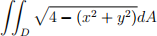
where D is the region bounded by the lines x + y = 1, x + y = 2, x = 0 and y = 0.
(8) Evaluate the integral  where E is the solid bounded by the sphere x2 + y2 + z2 = 4 and above the plane z = 1.
2025-07-25
Calculus