Miniaturizing the Large Hadron Collider
Hello, dear friend, you can consult us at any time if you have any questions, add WeChat: daixieit
Miniaturizing the Large
Hadron Collider
Important Disclaimers
• These slides are meant only to provide hints for your project
• They are not intended to provide a comprehensive guide to what you need to do.
• MSc, URECA, FYP, CNYang etc. are meant to highly self-motivated, self-driven projects
• Although these slides provide useful info and equations, please look up and understand the info and equations separately. You are not allowed to cite these slides in your report.
“I used this equation/algorithm because my advisor said so, but I don’t know why” is not ok!
• Please stay on top of all deadlines independently
Why you should take your project seriously
• Learning skills and gaining exposure in research [automatic]
• A well-written project report can be used to impress a future employer during the interview process
• Opportunity for publication in scientific journal
• Opportunity for presenting a conference paper abroad (e.g. in USA)
• Opportunity for winning global awards
• Opportunity to get a strong recommendation letter for job/MSc/PhD application in the future
In this project, your goals are to
• Understand how particle accelerators like those used in the LHC work, and the interest in miniaturizing them
• Understand how to use the Newton-Lorentz equation to model charges in electromagnetic fields
• Use ordinary differential equation algorithms (e.g., ode45 in Matlab) to simulate this
• Analyze, study and optimize how charged particles can be accelerated by different types of EM fields
Properties of a charged particle 1/3
• A classical point charge is defined by its charge and mass
• Charge is quantized – Elementary charge 1e = 1.6 × 10⁻¹⁹ C
• What is a point charge of charge 1e and mass 9.11 × 10⁻³¹ kg?
• What is a point charge of charge -1e and mass 9.11 × 10⁻³¹ kg?
Properties of a charged particle 2/3
• Charge and mass only tells us the type of particle
• What is the other information we are missing?
• Ans: Energy and momentum
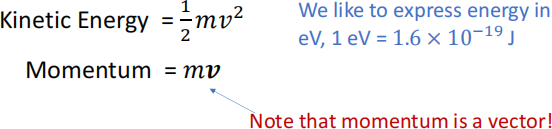
• For a nonrelativistic particle (speed v << c, c the speed of light),
Properties of a charged particle 3/3
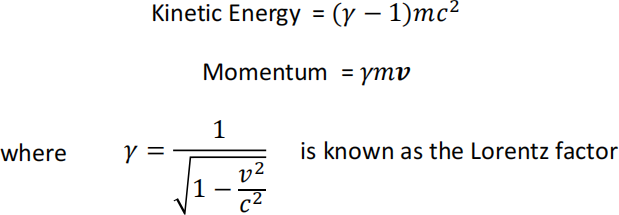
• But particles can be relativistic in general. What is a correct formula for both non-relativistic and relativistic regimes?
What does it mean to miniaturize the LHC?
• Bring particles of low momentum and energy to high momentum and energy over a very small distance
• Traditional accelerators rely on radiofrequency and microwave fields (λ~1 cm to 1 m)
• These wavelengths cause material damage when the fields are too intense, limiting the maximum electric field to ~10 MV/m
2025-07-24