Homework #5 Wind Energy Systems
Hello, dear friend, you can consult us at any time if you have any questions, add WeChat: daixieit
Homework #5 Wind Energy Systems
Question 1
The following wind measurements by bin are given for a proposed wind turbine location. Assume the air has a density of 1.15 kg/m3.
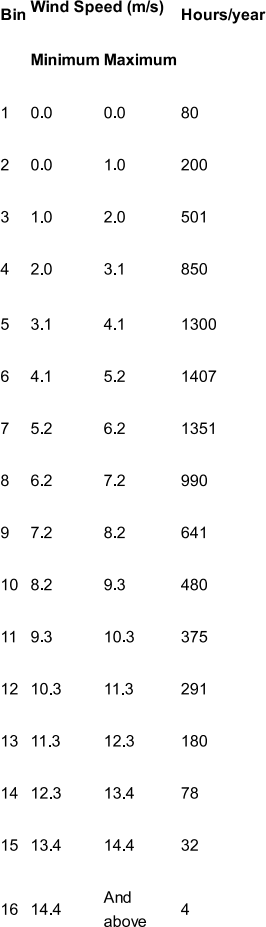
Calculate the total estimated energy available in the wind from the bin data, in kWh/m2. For bin 16, assume an average wind speed of 16 m/s. Provide your answer in kWh/m^2.
Question 2
For the data in Problem 1, calculate the estimated energy available in the wind using the average wind speed and the Rayleigh function. For bin 16,d assume an average wind speed of 16 m/s. Provide your answer ind kWh/m2.
Question 3
For the wind data in Problem 1, calculate the estimated energy using the relationship:
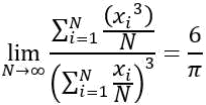
Provide your answer in kWh/m^2.
Question 4
Calculate the error between the actual energy value from (1) and the estimated values from (2). Provide your answer as a percentage. (ex., is your answer is 0.123, enter '12.3').
Question 5
Calculate the error between the actual value from (1) and the estimated answer from (3). (ex., is your answer is 0.123, enter '12.3').
Question 6
Estimating output from a turbine: the following data for a large turbine designed for high-wind areas are provided. The turbine swept area has a diameter of 80 m and you can assume an air density of 1.15 kg/m3. In the data below, bin 1 span from 0 m/s up to the cut-in speed of 6.25 m/s, and thereafter each bin spans a 0.5 m/s increment, for example, bin 2 is 6.25 to 6.75 m/s, and so on. Bin 18 spans from 14.25 to 22.25 m/s, and above 22.4 m/s the machine stops (i.e., this is the cutout speed). The device is being considered for use in a site with average wind speed of 9.6 m/s. Note that bin 18 has an approximate average wind speed of 17.25 m/s, reflecting the fact that lower speeds are more probable than higher ones within this bin.

Calculate the predicted total annual output for this device in the chosen location, using the site average wind speed and assuming the wind follows a Rayleigh distribution. Provide your answer in MWh/year.
Question 7
For the data in Problem 6, calculate the predicted capacity factor using the site average wind speed and assuming the wind follows a Rayleigh distribution. Provide your answer as a percentage (ex. if your answer is 0.123, enter '12.3').
Question 8
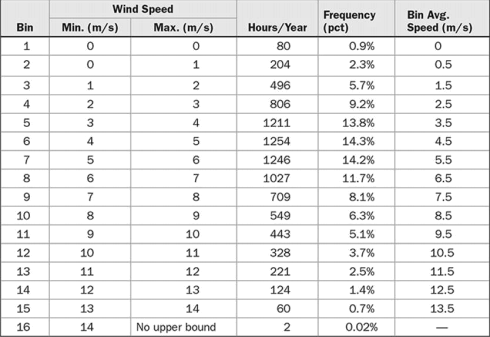
Suppose a small turbine rated at 10 kW has approximately the following power curve: U<4 m/s, P=0 kW; 4 m/s<U<10 m/s, P= (10/6)(U-4)kW; 10 m/s< Us20 m/s, P=10 kW; above 20 m/s, no output. Apply this power curve to the wind distribution of Table 13-1. What is the predicted annual output in kWh?
2025-07-09