Pipe-Sort
Hello, dear friend, you can consult us at any time if you have any questions, add WeChat: daixieit
Pipe-Sort
Learning Objectives
Upon completion of this assignment, you should be able:
1. Work in a multiprocess environment
2. Combine newly written processes with existing system utility processes
3. Gain facility with interprocess communication
New mechanisms you will see and use include:
0 system calls: fork, exec, wait, pipe, dup2
0 /usr/bin/sort, buffered I/O, String Routines
NAME
pipesort – An exercise in plumbing
SYNOPSIS
pipesort [n:s:l:]
DESCRIPTION
-n count Count is the number of sorters (default 1)
-s short Words must have more than “short” letters
-l long “long” is the maximum number of letters in a word.Letters beyond that are discarded
pipesort reads text from standard input and writes the unique words to standard output sorted in alphabetic order, using “count sorters”.
More than 1 sorter is an Extra Credit option, a good deal more difficult than the one sorter assignment. As before, don’t attempt it unless the basic assignment is perfect. You will get no points for the extra credit unless both are perfect, and could lose points if the multi-sorter code induces an error in the single sorter case.
Exit Status
pipesort returns 0 on success and 1 on failure
DISCUSSION
The output should have one word per line preceded with a count of how many times it appeared in the input.
Internally, the program must be organized into 3 types of processes. A single process reads the input parsing the lines into words, a group of processes does the sorting, and a single process suppresses and counts duplicate words and writes the output. You should organize the processes so that every parent waits for its children, and if any process exits in error the main process returns the error code in its exit.
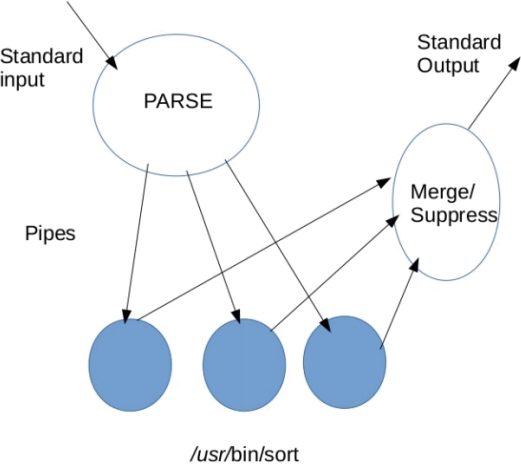
NOTES:
• You must use the system sort command (/usr/bin/sort) with no arguments to do the actual sorting,
• You must not use any disk files, or large amounts of memory. There is
NO LIMIT on how large the input may be, and you should test with large input files.
• If there is more than one sorter, Parse distributes the words round robin to the sorts
• All the I/O is done using the buffered I/O library (fget, fputc, etc), you will need fdopen for attaching to the pipes.
• Words are all alphabetic and case insensitive with the parser
converting all alphabetic characters to lower case. Any non-alphabetic characters delimit words and are discarded.
• The “short” and “long” parameters affect the parsing. Words with
“short” characters or less are discarded, words with “long” characters or greater are truncated to “long” characters.
• The output MUST have the count left justified in a 10 character field followed immediately by the word.
Example short=2 long=6
This is nonsense abc-def$@#abc some more of this
2 abc
1 def
1 more
1 nonsen
1 some
2 this
HAND in pipesort.c, makefile, any other files (README) in the
2025-06-19