CHEM442 - Structure and Dynamics of Molecules Spring 2025 Midterm 1
Hello, dear friend, you can consult us at any time if you have any questions, add WeChat: daixieit
Midterm 1
CHEM442 - Structure and Dynamics of Molecules
Spring 2025
1 QM General Knowledge (25 points)

(A) (5 points) Justify whether  is a valid quantum mechanical wave- function for the 1D particle-in-a-box Hamiltonian with boundaries at x = 0 and x =5.
(B) (5 points) Can classical physics describe the covalent bond in the molecule H2? Justify your answer.
(C) (5 points) A particle can exist on a 2-dimensional grid at three possible x locations (x1 , x2 , x3 ) and two possible y locations (y1 , y2 ). Write down a basis of kets and their corresponding numerical vectors capable of describing all mutually exclusive combinations of positions on the grid that the particle can be at.
(D) (5 points) Does Bohr’s model of the Hydrogen atom violate the Heisenberg Uncertainty principle? Why or why not?
(E) (5 points) In quantum mechanics, which of the following pairs of physical observables can be observed simultaneously and with arbitrary precision: x2 , px , py? Justify your answer.
2 de Broglie (25 points)
When using classical mechanics, one assumes that atomic nuclei behave as well-defined particles as opposed to waves. Let’s test how reasonable this assumption is for Lithium.
(A) (5 points) An atom at room temperature possesses roughly  Joules of kinetic energy. What velocity would a Lithium atom have with this amount of kinetic energy?
(B) (5 points) Compute the de Broglie wavelength for Lithium that possesses the kinetic energy described in (A).
(C) (5 points) Imagine that a container is filled with Lithium atoms until the average spacing between Lithium atoms is 8.1 * 10-7m. The temperature of the container after being filled changes to 315K. Do you expect the Lithium atoms to behave quantum mechanically in this container?
(D) (5 points) Assuming that the kinetic energy of a particle decreases as a function of tempera- ture according to the expression provided in (A), how low would you need to lower the temperature such that Lithium has a de Broglie wavelength larger than the average spacing between atoms in (C)?
(E) (5 points) Use the results of this problem to make a general statement (one sentence) about how mass and temperature in丑uence how “quantum mechanically” a particle will behave.
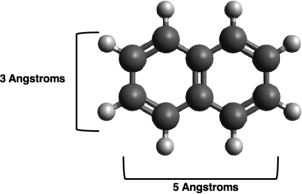
3 Particle-in-a-Box (25 points)
The particle-in-a-box is a reasonable model for understanding the optical spectrum of the two- dimensional molecule naphthalene.
(A) (3 points) Compute the energy (in Joules) of the 7 lowest energy eigenstates of an electron in naphthalene using the 2D particle-in-a-box as a model for its electronic structure.
(B) (3 points) Naphthalene possesses 10 π electrons. Fill up the available 2D PIB energy levels you calculated in (A) using the Pauli principle and compute the wavelength of light needed to promote a transition from the highest occupied energy level (HOL) to the lowest unoccupied energy level (LUL).
(C) (4 points) Imagine that instead of directly promoting the transition from HOL to LUL, the absorbed light puts the electron into a superposition state (linear combination) of the HOL state and the LUL state. This superposition state contains three times as much of a contribution from the HOL as it does from the LUL. Write down the normalized wavefunction for this system using bra-ket notation.
(D) (3 points) Using the answer you wrote in (C), calculate the expectation value of the energy for this superposition state. Then evaluate the numerical truth of the question “is the system in the HOL state?”
(E) (3 points) With the electron existing in the superposition state you wrote down in (C), an experimentalist then observes the energy of the electron on 44,000 independent occasions. What possible values of the energy of the electron (in Joules) can the experimentalist observe in any single experiment?
(F) (4 points) If the experimentalist performs 44,000 independent observations of the naphthalene electronic state in (C), approximately how many of these observations will be of the HOL and LUL states, respectively?
(G) (5 points) Sketch the position in the molecule where, on average, you expect to find the electron in the state in (C). Justify mathemetically why you chose this position. You can assume in the picture above that x = 0; y = 0 occurs in the bottom left of the image.
4 No Boundaries (25 points)
We have solved for the wavefunction of a quantum particle in a 1D box in which infinitely high potentials exist at the boundaries of the box. However, we have not discussed what the solutions are for a particle without boundaries in which the potential energy, V(x), is zero for all x.
(A) (3 points) Show that Ψ(x) of the form e+kx is a valid solution of the Schrodinger equation without boundaries. Determine what k must be in terms of m, h, and E. Also determine whether k must be real, imaginary, or if either is an acceptable solution.
(B) (3 points) There is also a second equally valid solution to the Schrodinger equation without boundaries - find what this is and show that it is also a solution.
(C) (4 points) Based on the solutions for Ψ(x) you wrote down in (A) and (B), what limitations must be placed on the value of the energy E?
(D) (4 points) The solutions to the Schrodinger equation in (A) and (B) are eigenfunctions of the Hamiltonian operator, but they are also eigenfunctions of another operator we have discussed. Identify this operator by proving that both solutions are eigenfunctions of that operator, and calculate the values of the experimental observables corresponding to each of the two solutions.
(E) (4 points) Based on your answer to (D), provide a physical interpretation for the two diferent solutions as it relates to the particle’s physical properties.
(F) (4 points) What is the uncertainty in the momentum, σp, for the particle without boundaries? What does this imply about the uncertainty in the position, σx?
(G) (3 points) Using the wavefunction from part (A), calculate the probability density Ψ* (x)Ψ(x)dx and determine if this computed quantity is consistent with your interpretation in (F).
2025-02-22